Table of Contents
- 1. What Microsoft's earnings said about LinkedIn
- 2. billion members is not 1.4 billion readers
- 3. Time spent is the number LinkedIn is managing to
- 4. The cleanup produced these numbers, so the cleanup stays
- 5. What to do now
- 6. Frequently asked questions
- 6.1. How many people actually use LinkedIn every month?
- 6.2. Is LinkedIn growing?
- 6.3. Do engagement pods still work on LinkedIn?
Short on time? Microsoft's earnings on October 28, 2026 put LinkedIn past 1.4 billion members, with time spent up 15% year over year and ads featuring creators up 63%. Two things in those numbers change how you should post. First, the coverage credits the engagement growth to LinkedIn's feed cleanup, the AI-slop reporting and the crackdown on engagement pods, which means the cleanup now has the strongest constituency a policy can have: it produces the number the CEO reports to investors. Second, 1.4 billion is members, not readers. The same report estimates monthly actives at roughly 420 million. Size your expectations to the smaller number and write for held attention, because that is the metric LinkedIn just told everyone it is managing to.
What Microsoft's earnings said about LinkedIn
Microsoft posted its FY27 Q1 results on October 28, 2026: $92.3 billion in revenue, up 19%. LinkedIn's numbers arrived alongside, in a post from LinkedIn CEO Daniel Shapero, reported by Social Media Today's Andrew Hutchinson on October 29. Time spent on LinkedIn rose 15% year over year. Membership passed 1.4 billion, up from 1.3 billion a quarter earlier. Paid video ads grew 25%, ads featuring creators grew 63%, and Premium Company subscriptions were up 121%.
One thing the earnings release does not contain is a LinkedIn revenue line. Microsoft recast its reporting segments in September 2026, and the headline tables now split the company into Agents and Infra and Devices and Consumer, with LinkedIn folded in rather than broken out. The engagement and membership figures come from Shapero's post, not from the financial statements. That does not make them wrong, but it does make them chosen: these are the numbers LinkedIn wanted to talk about. Which is useful in its own way, because what a platform brags about is what it will keep optimizing for.
1.4 billion members is not 1.4 billion readers
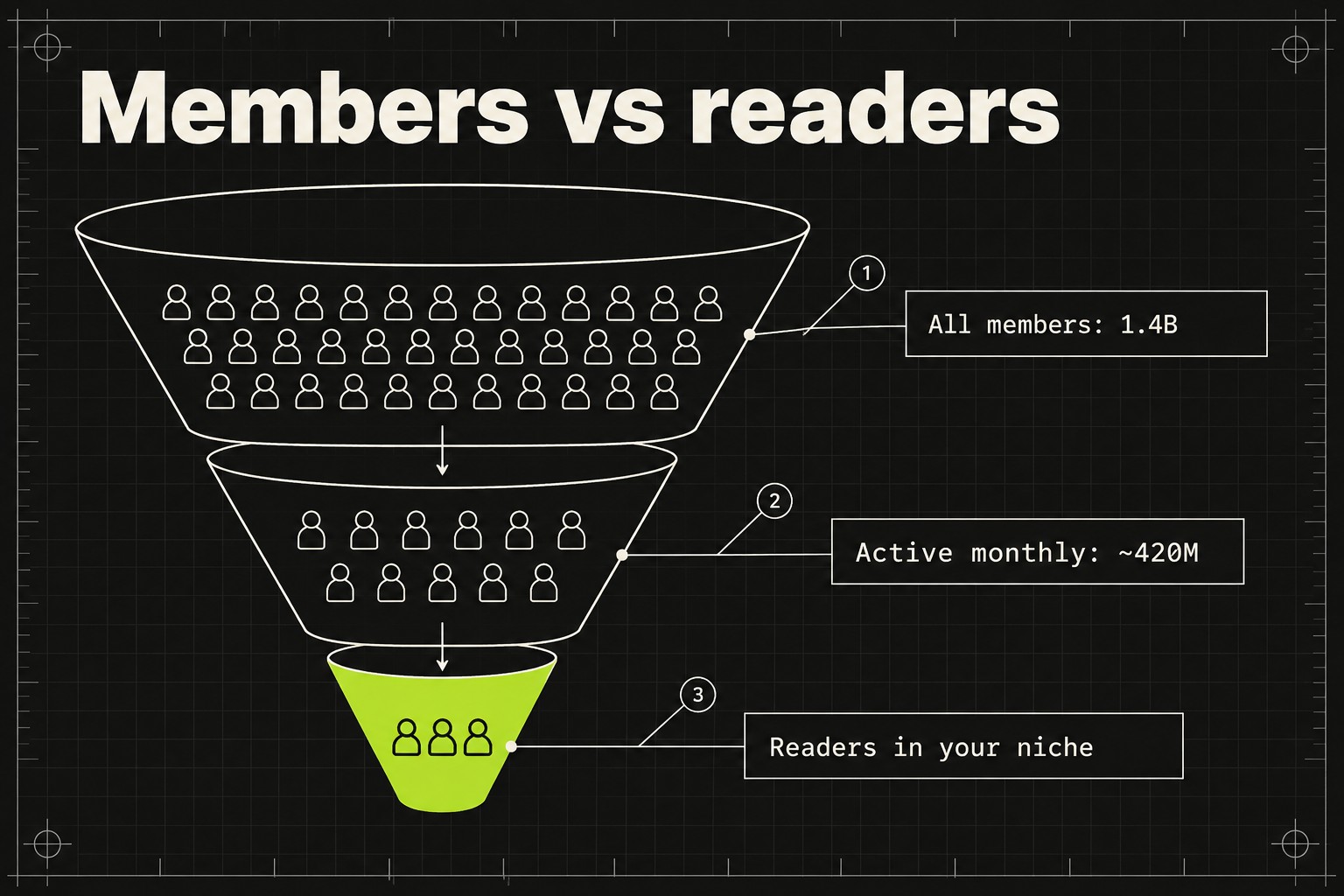
Members means accounts, not activity, and Hutchinson flags the gap in the same piece. The EU is the only region where LinkedIn has to publish active user counts, under the DSA, and there the share of members active in a month has stayed between 28% and 30%. Apply that ratio to 1.4 billion and you get roughly 420 million monthly actives. That is his estimate, not an official figure; LinkedIn does not publish a global one.
The gap matters if you post. The pitch in every growth thread, a billion-plus professionals waiting to find you, overstates the pool by about a factor of three before you narrow it to your language, your niche and the people whose feeds your post could actually enter. That arithmetic is also the honest answer to a frustration you can read any week on Reddit. In a thread last week, a poster averaging two engagements after 30 days asked what they were doing wrong, and the most practical reply was blunt: "LinkedIn organic is difficult now (it was much easier before)", paired with the advice to start by engaging with other people's content rather than broadcasting your own. The platform's totals go up every quarter. Your reach was never a share of the total.
Time spent is the number LinkedIn is managing to
Of everything Shapero could have led with, he led with time spent. That fits what the feed has measured since 2020, when LinkedIn added dwell time to its ranking, a mechanism we unpacked when it started testing longer post previews this month. It also fits where the industry went this autumn: X now ranks posts partly by how long people actually stay on them. Platforms report the metric they manage to, and a 15% rise says the approach is working, so expect more of it. More weight on reading over clicking, more tests that surface substance earlier, less patience for formats that win a tap and lose the reader three seconds later.
For a writer, the practical translation has not changed since the previews piece: your opening lines have to carry value rather than advertise it, because held attention is scored whether or not anyone clicks.
The cleanup produced these numbers, so the cleanup stays
Hutchinson connects the engagement growth to a year of feed-quality work: the option to report AI slop added in August, a continuing crackdown on inauthentic activity that names engagement pods and paid third-party automated engagement tools, and the Network tab test built to get people engaging with people they know.
Read that as policy, not mood. When a cleanup gets credited with producing the engagement number the CEO reports next to Microsoft's earnings, the cleanup has won the internal argument. Pods and purchased engagement dilute the metric LinkedIn now shows investors, and that is a far more durable reason to hunt them than a rules violation ever was.
The 63% growth in ads featuring creators sharpens the same point. LinkedIn is selling creator credibility to brands, the business logic behind the ad revenue sharing it opened to creators. Fake engagement devalues exactly the product being sold. A platform earning real money from genuine creator influence has a standing commercial reason to keep genuine creators visible and to police the imitation kind, and that protection is worth more to you than any tactic.
What to do now
Four moves, in order of urgency.
- This week: get out of any engagement pod or paid engagement loop. The crackdown names them, and they now work against the headline metric. Reach built on them is borrowed and the repossession is scheduled.
- This week: reread your openings for held attention. Time spent is the reported number and dwell is the ranking signal. An opening that delivers something concrete in the first two sentences earns the metric; a tease does not.
- This month: resize your targets using actives, not members. Roughly 420 million people a month, cut down to your language and niche, is the real arena. Two engagements on a post into that pool after 30 days is a starting point, not a verdict.
- This month: if you have an audience, look at the money. Creator ads growing 63% in a year means brands are buying creator placement at scale, and the revenue sharing program is how LinkedIn routes some of that to the people writing the posts.
One thing not to do: do not read member growth as easier reach. More members did not mean more readers this quarter, and attention in the feed is still zero-sum.
Frequently asked questions
How many people actually use LinkedIn every month?
LinkedIn does not publish a global active user count. It passed 1.4 billion members in October 2026, and its EU disclosures, the only region with mandatory figures, show 28% to 30% of members active in a month. Social Media Today's estimate on that basis is roughly 420 million monthly actives worldwide.
Is LinkedIn growing?
Yes, on the numbers it shared for the quarter ended September 2026: members up from 1.3 to 1.4 billion in a quarter, time spent up 15% year over year, paid video ads up 25%, ads featuring creators up 63%, and Premium Company subscriptions up 121%. Microsoft's recast segments no longer break out LinkedIn revenue, so there is no independent revenue growth figure in the release.
Do engagement pods still work on LinkedIn?
They are explicitly targeted. The coverage of this quarter's results notes a continuing crackdown on inauthentic activity, naming engagement pods and paid third-party automated engagement tools, and that cleanup is being credited with the engagement growth LinkedIn just reported. Betting a content strategy on a mechanism the platform profits from removing is a bad trade.
The bottom line: as of October 2026, LinkedIn is growing on the metric that rewards real reading, and crediting that growth to the removal of fake engagement. Write openings that hold attention, size your ambitions to the 420 million who show up rather than the 1.4 billion who signed up, and let the pods die without you.