Short on time? LinkedIn has published its first engineering-level account of how it detects AI slop. VP of Engineering Tim Jurka says the classifiers now screen every post distributed beyond your immediate network, at 94% precision, and they learn from the million-plus slop reports members have filed since July. Read that placement carefully: reach past your own followers, the reach everyone building an audience is chasing, is now the screened zone. LinkedIn keeps repeating that AI use is allowed; what the classifiers hunt is generic copy-paste output. As of October 2026, the practical rule is simple. A post earns distribution beyond your network only if it says something a model could not have said for you.
What LinkedIn published on 8 October
On 8 October 2026, Tim Jurka, LinkedIn's VP of Engineering, published The Technology Behind LinkedIn's Fight Against AI Slop, the company's first technical description of the detection system behind this year's crackdown (Social Media Today, 8 October 2026).
The background, quickly. LinkedIn added a "seems like AI slop" report option at the end of July, and members used it more than a million times in under three weeks (The Register, 24 August 2026). Chief Product Officer Hari Srinivasan said then that accounts copy-pasting AI-written posts were already seeing around 40% fewer views than before the button existed. LinkedIn has separately reported that views of content its classifiers mark as slop are down about 40%.
The classifiers have plenty to eat. Pangram's detector scanned more than a million posts across five platforms between April and June 2026 and flagged 41% of long-form LinkedIn posts as fully AI-generated. LinkedIn supplied about a third of the posts in the sample and nearly two thirds of all the AI content found (The Decoder, 12 July 2026, reporting Pangram's data). You can argue with any detector's accuracy. You cannot argue that the pool is small.
Teacher models, student models and policy agents
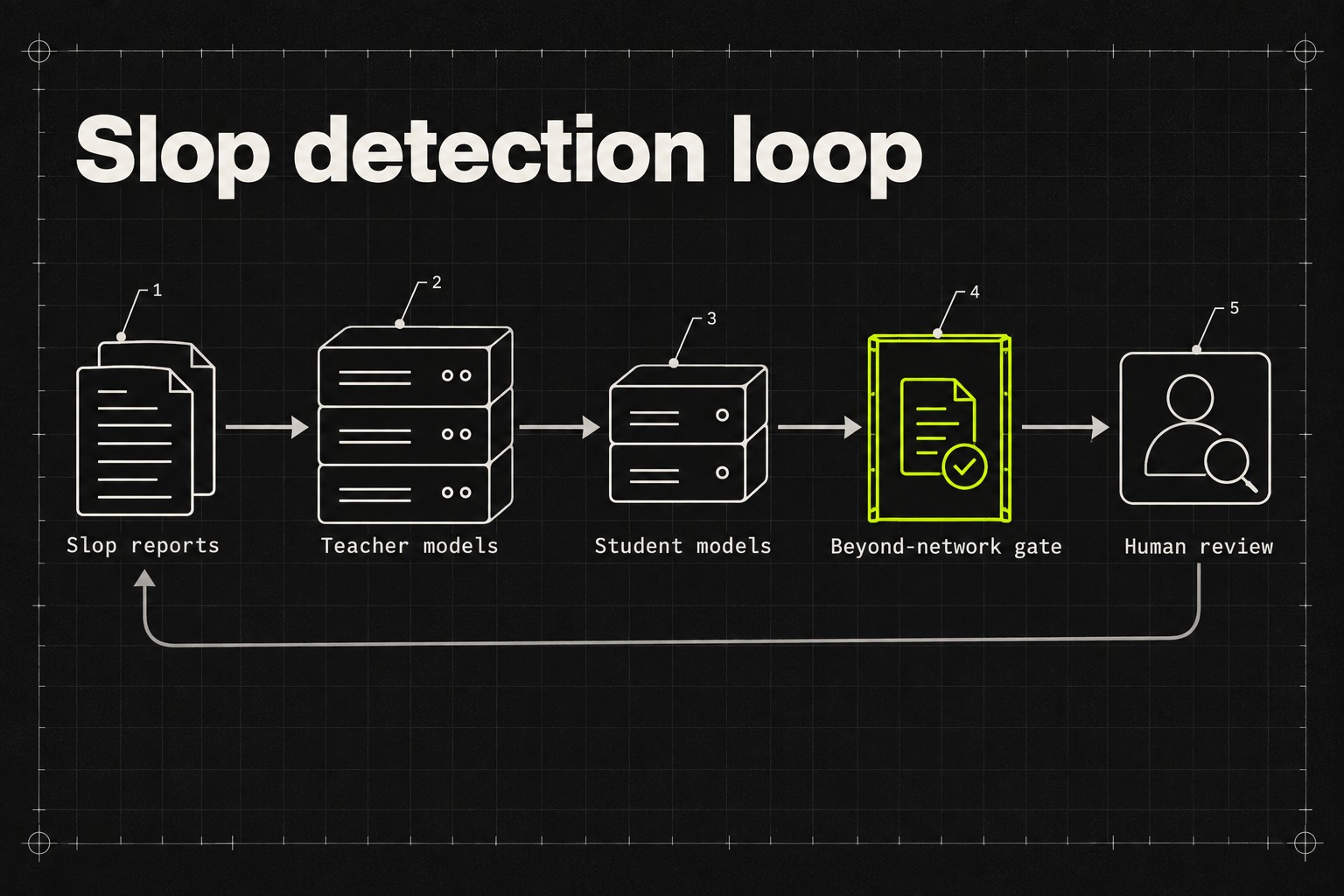
Jurka describes a two-layer system. Large "teacher" models study what members report and work out what new slop looks like. Small "student" models learn from the teachers and run cheaply at feed scale. In his words: "The larger 'teacher' models are designed to keep up with new AI-slop patterns and accurately identify them, which generates the high-quality training data we need to 'teach' or train our smaller models to pick up on those new patterns rapidly."
Every tap of the report button is free labelling work for that teacher model. A million taps is a labelled dataset most ML teams would pay serious money for, and LinkedIn's members produced it in weeks, for nothing, out of irritation.
On top of the classifiers sit AI agents, each assigned one content policy. "Each agent is guided by a specific policy, which defines the criteria it uses to evaluate content, such as whether a post is promotional, celebrates an achievement, or is timely," Jurka writes. When an agent hits a case it cannot reason about, it escalates to a human reviewer, takes the guidance, and folds it back into its policy. The loop runs continuously: reports train teachers, teachers train students, agents patrol policies, humans settle the hard calls.
The six words that matter: "beyond your immediate network"
The line worth rereading is this one: "we've recently expanded our classifiers to cover all posts that are distributed beyond your immediate network with 94% precision at detecting AI-slop."
Two things are packed in there. The first is placement. LinkedIn distribution has two stages: your post goes to your own connections and followers, then the feed decides whether to push it further. That second stage is where growth happens, and it is exactly where the classifier now sits. A generic post now meets a screen at the one gate that separates an audience of people you already know from an audience of people you want to reach.
The second is what 94% precision does and does not claim. Precision measures false alarms: when the classifier flags a post as slop, it is right about 19 times in 20. It says nothing about how much slop slips through unflagged. That figure is recall, and LinkedIn has not published it. The tuning choice is still good news for honest writers, because a system built for high precision is a system built to avoid punishing real writing by mistake. Srinivasan has also said that no single slop report changes how widely a post travels; distribution rests on a range of signals. One annoyed reader cannot bury you. A pattern of them, fed through a teacher model, can.
What this means if you grow by posting and commenting
Non-follower reach is now a screened surface. Most LinkedIn growth advice assumes the main fight is relevance: post good content, win the ranking auction. There is now a checkpoint before the auction. If you depend on reach beyond your network, and every founder or consultant building an audience does, the slop classifier is part of how the LinkedIn algorithm treats your post whether you think about it or not.
Comments sit in the same net, and have for months. Back in August, Srinivasan said LinkedIn was already catching hundreds of thousands of AI-slop comments every day, alongside billions of blocked automation attempts. Jurka's post explains the machinery that does it. If a tool writes comments for you, the only output worth publishing is a comment that responds to the specific post, which is the standard our commenting guide argues for and the bar we hold Commentify to. Template praise is training data for the teacher model now.
The policies name the genres under the microscope. Jurka's examples of what agents evaluate are promotional posts, achievement posts and timely posts. That reads like a list of the three most templated formats on the platform, and templated formats are the easiest to pattern-match. If your content calendar is product plugs, congratulations and news reactions, you publish in the most legible categories the agents patrol. The format is not banned. It just leaves you nowhere to hide if the words are generic.
Do not expect the reporting to slow down either. The irritation that produced a million taps is still everywhere. "AI just supercharged all the lunatics posting this motivational virtue-signalling junk," wrote one Reddit user this week, in a thread of people trading screenshots. Every one of those people is a future tap on the button.
What to do now
Four moves, in order of urgency.
- Reread your last ten posts cold. If a post could have appeared under a stranger's name without anyone noticing, it belongs to the pattern pool the teacher model studies. Keep the topics, rewrite the process that produced them.
- Give AI a role the classifier cannot see. Your observation, your numbers, your position first; AI tidies afterwards. Pattern detectors read the surface of finished text, and editing your own words leaves a different surface than generating them. Our guide to avoiding AI content pitfalls covers the workflow.
- Watch your analytics for the new feedback messages. Srinivasan said dashboards will start relaying how viewers perceive your AI use. If that message appears, treat it as a process warning, not a topic problem.
- Audit the genres you lean on. Promo, congratulations and news reactions are fine to publish and easiest to flag. In those formats, the specific detail that only you know is what separates a post from the template next to it.
One thing not to do: run old generic posts through a "humanizer" tool and repost them. Jurka's entire point is that the teacher models exist to keep up with new patterns. Detector versus detector is a trade you lose on someone else's hardware, with your account as the stake.
The bigger picture
Platforms almost never explain their moderation machinery. LinkedIn has now done it twice in three weeks, once as a product decision and once as an engineering post. The proofreader swap in September drew the product line: AI that edits your words is a feature, AI that produces them is a liability. Jurka's post draws the technical line underneath it. Both point the same way. As of October 2026, LinkedIn is openly spending engineering effort to make generic content worthless, and the cheapest durable response is the old one: write things only you could write, and let the machines do the tidying.