Table of Contents
Short on time? On October 20, 2026, Elon Musk announced two changes to how X assembles the For You feed: a new ranking model that predicts how long you will spend on a post, and a retrieval model trained to surface posts people read all the way through. Likes and reposts still count, and X has not said how the signals are weighed against each other. But the direction is plain: the feed is now hunting for posts that hold a reader to the last line. If you grow on X, the hook-and-bail playbook just got weaker, and the case for writing posts people actually finish got stronger.
What X announced on October 20
Musk described the update in a post on X on October 20, 2026 as "two important changes to timeline recommendations": a "new AI/SI ranking model that predicts probable time spent much better" and a "retrieval model trained to surface posts people read all the way through." He paired it with a chart of daily user active seconds and the claim that the metric is "growing exponentially and hitting all-time highs almost every day."
Treat the chart as a claim rather than a finding. As Tom's Guide noted in its October 20 coverage, the figures have not been independently verified, X has not said how much influence the new models carry against likes, replies and reposts, and there is no published deployment timeline. TeslaNorth's report adds the backstory: Musk said in October 2025 that X was working to delete the heuristics in its recommendations entirely, and the company has been publishing the algorithm's code on GitHub since January.
Retrieval and ranking are two different doors
The announcement names two models because the feed is built in two stages, and the stages gatekeep differently. X's published algorithm repository lays the pipeline out: the For You feed is assembled per request, candidate posts come from the accounts you follow plus out-of-network sources, and a model called Phoenix scores each candidate by predicting the probability of every action a viewer might take on it. Retrieval decides which posts enter that candidate pool at all. Ranking decides the order of the ones that made it in.
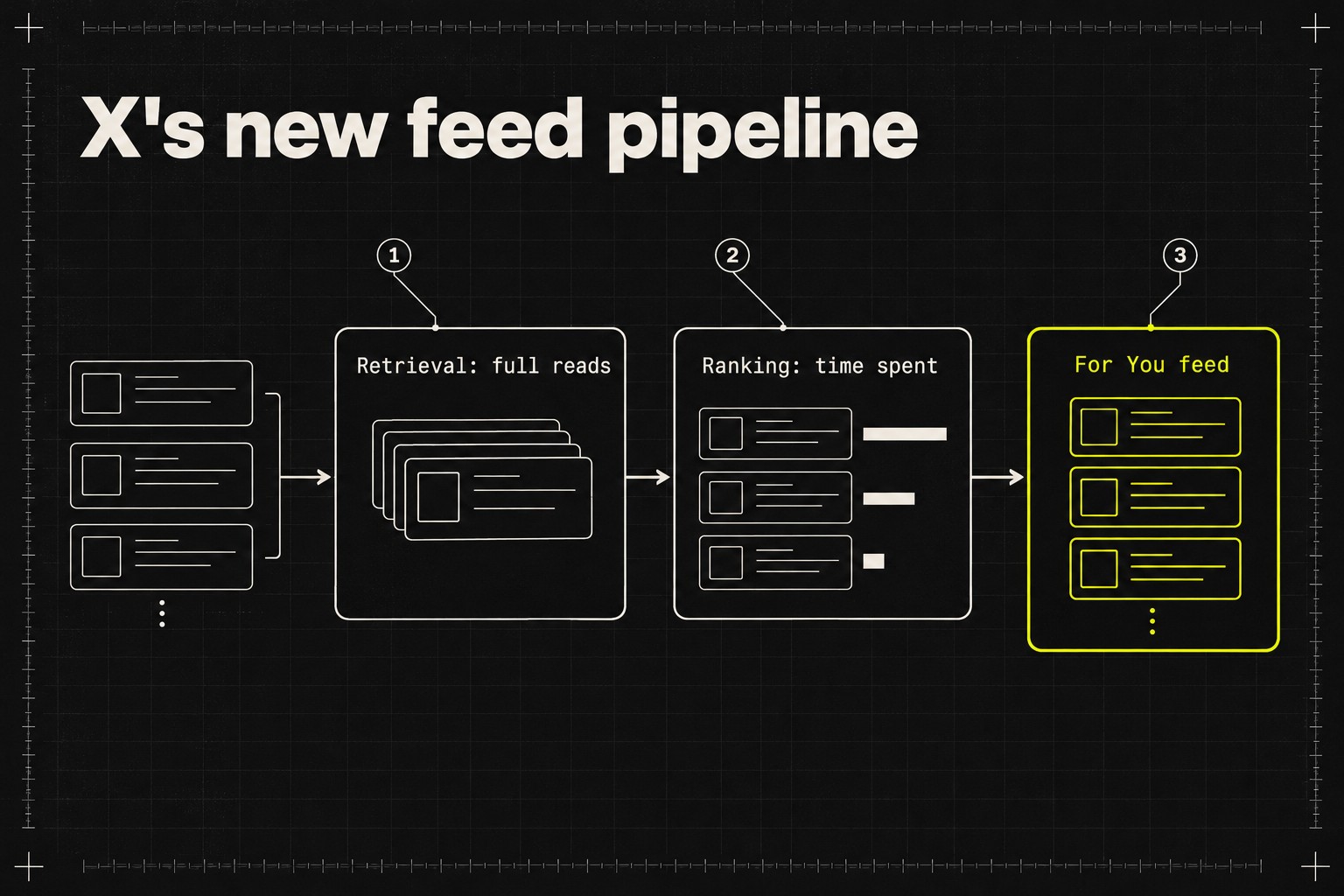
That is why the retrieval change is the bigger one. A post that nobody finishes now struggles to get into the room, before ranking ever looks at it. And the published code shows the ranking stage was never a raw engagement counter: predicted probabilities are blended by weights held in the code, then adjusted by a repeated-author decay, a discount on out-of-network posts and a boost for new authors. The repository's home-mixer and Phoenix components took fresh commits on October 20 and 21, though Musk has not said whether the new models are in the published code yet, a gap TeslaNorth also flagged.
What this means if you grow on X
The immediate loser is the post engineered to be reacted to rather than read. "Agree?" bait, engagement-farming polls and hooks that promise more than the post delivers can still win replies, but a reply prediction is no longer the whole game. A reader who taps in, feels tricked and scrolls away now leaves a measurable mark exactly where the new models are looking.
The popular reading of the change is "write long threads." I think that is backwards. The retrieval model is trained on whether people read a post all the way through, and completion is a ratio: a tight 80-word post that everyone finishes is a perfect read-through, while a 1,500-word thread abandoned at the second tweet is the opposite. Tom's Guide made the same point, and it matches how the published scorer treats dwell time as one predicted value among many. Length only helps when every line earns the next one.
The quiet winner is the small account that holds attention. X already recommends posts from accounts you do not follow, and a retrieval stage trained on full reads can pull a low-like post from an unknown author into the pool on its reading behaviour alone. Add the new-author boost documented in the ranking code and the path from zero audience to real distribution runs through depth, not volume.
One honest caveat belongs here: time spent is not quality. An outrage post or a deliberately suspenseful one holds attention as well as a useful one does, and the model cannot tell the difference. Expect some of what the new feed surfaces to be worse, even while the incentive for your own writing gets better.
If you grow by commenting as much as posting, the change shifts where your comments should go. A reply lives or dies with the post above it, and the posts that keep circulating under a read-through regime are the substantial ones. A thoughtful comment on a post people finish gets seen for days; the same comment under bait sinks with the post. Target accordingly. This is the daily targeting work Commentify does for you when you cannot sit in the feed.
What to do now
Four steps, ordered by urgency.
- This week: reread your last ten posts and find the exit points. The sentence where a reader would stop is now the sentence that costs you distribution. Cut the throat-clearing, and make the hook a promise the post actually keeps.
- This week: keep the short-post habit. Completion favours tight writing. Do not stretch a two-paragraph idea into a thread because "long wins" is going around; the abandonment shows up in exactly the signal X says it is now measuring.
- This month: move your commenting toward posts people finish. Deep posts circulate longer under this regime, and your reply inherits that shelf life. If LinkedIn is your other feed, our guide to how the LinkedIn engagement algorithm works in 2026 covers the equivalent mechanics there.
- This quarter: judge the change by your own numbers, not the announcement. X has published neither the weights nor the rollout dates, so watch your impressions and follower curve for a few weeks before rebuilding your content plan. If you pull your own data to do that, know what the unofficial X API can and cannot safely do in 2026 before wiring anything up.
Two things not to do. Do not pad posts with filler to farm seconds; the retrieval model is trained on finished reads, and a reader who bails halfway through padding is the signal you were trying to avoid. And do not respond by generating volume with AI. X's feed now pays for writing people finish, and LinkedIn is running the same war from the other side by burying generic AI posts, so mass-produced filler now loses on both platforms you care about.
Frequently asked questions
Did X change its algorithm in October 2026?
Yes. On October 20, 2026, Elon Musk announced a new ranking model that predicts probable time spent on a post and a new retrieval model trained to surface posts people read all the way through. X has not published a deployment timeline or said how heavily the new signals weigh against likes, replies and reposts.
Do longer posts now rank better on X?
Not automatically. The retrieval model is trained on whether people read a post all the way through, which is a completion ratio rather than a duration. A short post everyone finishes can beat a long thread most readers abandon, so length only helps when it sustains attention to the end.
Do likes and reposts still matter on X?
Yes. X's published algorithm predicts the probability of many actions, including likes, replies and reposts, and blends them into one score using weights held in the code. The October 2026 announcement adds attention signals to that blend; it does not say engagement signals were removed.
The bottom line: as of October 2026, X says its feed will find and favour posts people finish. The weights are unpublished, the chart is a claim, and some of what wins attention will not deserve it. But the incentive now points the same way your readers always did: write the post someone reads to the last line, and put your comments under posts built the same way.