Table of Contents
- 1. What LinkedIn announced on October 15
- 2. Every earning path has a gate
- 3. The other half: generic content keeps getting buried
- 4. Pinned comments are the sleeper feature here
- 5. What to do now
- 6. Frequently asked questions
- 6.1. What are LinkedIn Advice Sessions?
- 6.2. How do creators earn ad revenue on LinkedIn?
- 6.3. Can anyone pin comments on LinkedIn now?
Short on time? On October 15, 2026, LinkedIn announced three ways to earn money directly on the platform: a share of ad revenue on video through In-Stream Ads, paid one-on-one consultations called Advice Sessions, and new search filters that help brands find creators to sponsor. It also brought back pinned comments. Every earning path runs through a gate that proves you are a real person with checkable expertise: an opt-in, a profile verification, a searchable specialty. If you grow on LinkedIn by posting and commenting, the audience you have been building just got a price attached, and LinkedIn told you exactly what it will inspect before paying out.
What LinkedIn announced on October 15
LinkedIn published the bundle on its newsroom on October 15, 2026. The money features: In-Stream Ads, a test that places pre-roll ads on creator and publisher videos and gives the creator a portion of the ad revenue; Advice Sessions, which let Premium subscribers offer free or paid consultations booked and paid on LinkedIn itself; new Creator Marketplace search filters so brands can find creators by expertise, audience focus and preferred content formats; and a profile dashboard that puts content performance and monetization opportunities in one place.
Two details from Social Media Today's report matter more than the headlines. First, In-Stream Ads do not require an existing brand partnership. Advertisers buy placement against topically relevant video, and creators sign up to make their content eligible, so the revenue share reaches people who never landed a sponsorship deal. LinkedIn has not said what portion of the revenue creators get, and calls the whole thing an early test. Second, Advice Sessions require a verified profile. LinkedIn's VP of Product Oscar Rodriguez said verification is a requirement so members can trust who they are learning from. Sessions are live for US hosts now, with other countries to follow.
The same announcement expands the Network feed test we covered when LinkedIn split the feed into Network and For You tabs: it is now rolling out in the US, India, the UK and Australia. And buried near the bottom: "Authors can now pin helpful comments, making it easier to highlight valuable contributions and guide the discussion." More on why that line matters below.
LinkedIn frames all of it as side-hustle infrastructure. By its own numbers, the count of founders on the platform is up 70%, and more than 80% of LinkedIn creators build content alongside another role.
Every earning path has a gate
Look at the three paths together and a pattern shows up. Ad revenue requires an opt-in. Paid consultations require identity verification. Sponsorships flow through a marketplace that indexes you by expertise and audience, which means brands find you by what you are demonstrably known for rather than by how loudly you post. Being active earns none of this. What gets paid is legibility: a real person, a clear subject, an audience that chose them.
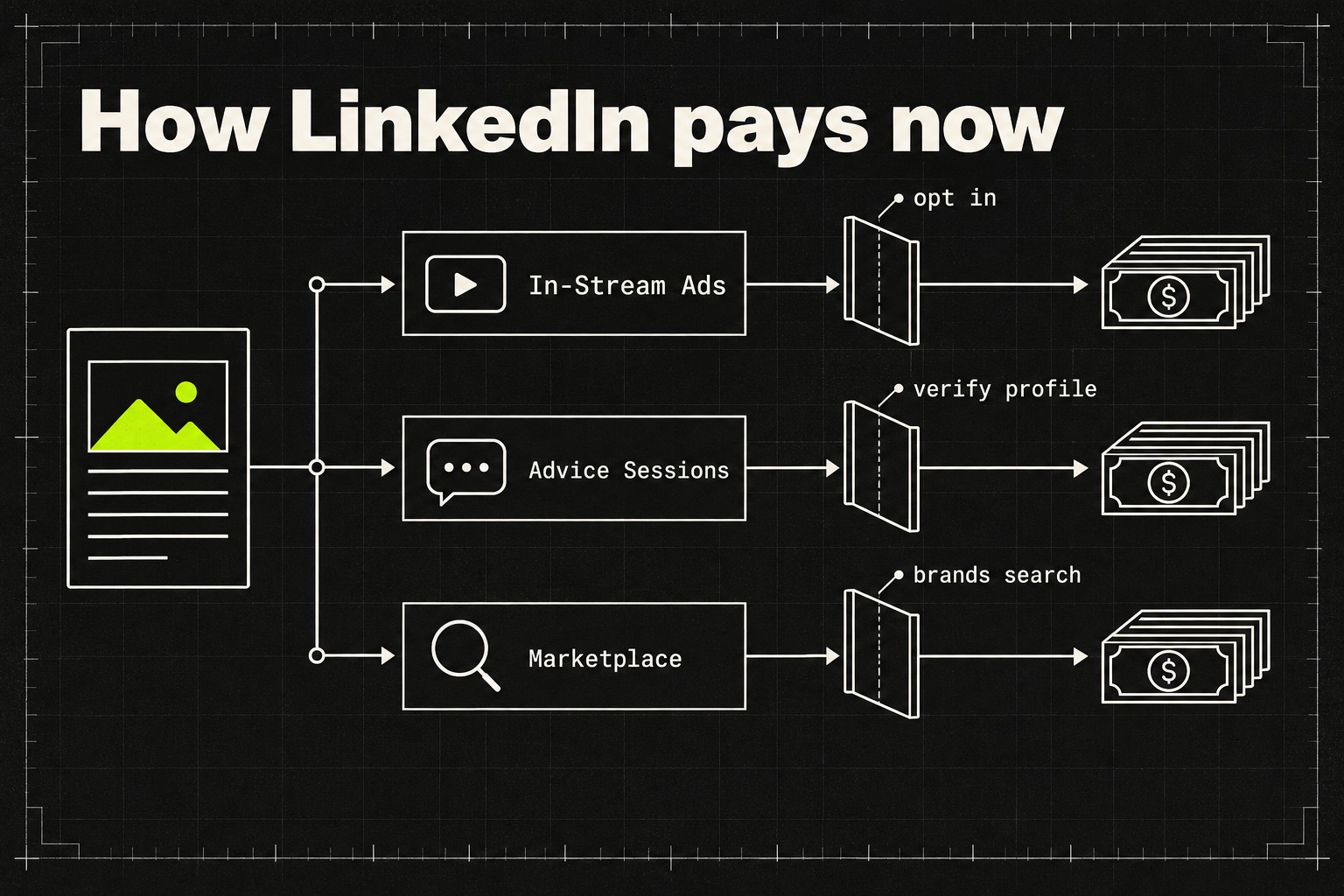
The gates make more sense when you put them next to what LinkedIn spent the same month doing to everyone else.
The other half: generic content keeps getting buried
A week before this announcement, on October 8, LinkedIn's VP of engineering Tim Jurka published a breakdown of how the platform hunts AI slop: AI agents review posts shown beyond your own network, each judging a single trait. LinkedIn puts its detectors' accuracy on generic writing at 94%, a figure Inc. highlighted this week while arguing the two moves add up to what writer Iza Montalvo calls a human premium. In July, LinkedIn retired its own built-in post writer and added a "seems like AI slop" report button, which we dug into when LinkedIn explained its slop detection.
Read as one policy, the direction is plain. LinkedIn is sorting accounts into two piles. Generic, templated, mass-produced content gets its reach cut. Identifiable experts with real audiences get a revenue share, a booking page and a storefront in front of brands. The gap between the piles is now measured in money rather than impressions.
Pinned comments are the sleeper feature here
For anyone who grows by commenting, the one-line pinned comments note is worth more than the ad revenue test. Until now, a sharp comment on a big post had a visibility window that closed as newer comments piled on top. A pinned comment does not scroll away. When an author pins your reply, you hold the top slot under their post for as long as it keeps circulating, in front of an audience you did not build.
It works in both directions. On your own posts, you can pin the reply that frames the discussion you want, which is a small editorial power authors have been asking for since LinkedIn briefly shipped pinned comments to some users in 2022 and then shelved the option, a history Social Media Today traced in its coverage.
The practical change: comment quality now has a prize beyond profile visits. The habits in our guide to how LinkedIn comments work in 2026 already pointed at writing the one reply an author actually values. Now that reply can get pinned, and a pinned comment on a post your buyers read is the cheapest durable placement on the platform.
What to do now
Four moves, ordered by urgency.
- This week: verify your profile. Verification is already the gate to Advice Sessions and LinkedIn says trust features will lean on it further. It costs nothing and removes the one blocker you cannot fix the day you need it.
- This month: write comments worth pinning. A few genuinely useful replies a day on posts your buyers already read was the play before this announcement. The pin option raises its ceiling: one author's pin can hold your name at the top of a circulating post for weeks. This is the daily habit Commentify runs for you when you cannot sit in the feed.
- This month: pick the subject you want to be found for. The marketplace filters index expertise, and the slop detectors reward firsthand specificity. An account about one thing wins both systems. We saw the same logic when LinkedIn opened its Creator Discovery beta: brands search by niche, so accounts without one do not come up.
- When it reaches you: opt into In-Stream Ads if you post video. It is an early test and the revenue split is unpublished, so treat it as found money rather than a plan.
Two things not to do. Do not rush to paywall advice before anyone is asking for it; an empty booking page next to a thin profile reads as a red flag, and the feature rewards people whose inbound already exceeds their calendar. And do not respond to a monetization push by generating more volume with AI. That is the exact pile the detectors are built to bury, and the 94% figure says they are good at finding it.
Frequently asked questions
What are LinkedIn Advice Sessions?
Paid or free one-on-one consultations that Premium subscribers can offer directly from their profile, with booking and payment handled inside LinkedIn. Hosting requires a verified profile, and as of October 15, 2026 the feature is available to US hosts only, with expanded access promised.
How do creators earn ad revenue on LinkedIn?
Through In-Stream Ads, an early test that places pre-roll ads on creator and publisher videos and pays the creator a portion of the revenue. Creators sign up to make their content eligible, and no existing brand partnership is required. LinkedIn has not published the revenue split.
Can anyone pin comments on LinkedIn now?
Post authors can pin comments under their own posts, per LinkedIn's October 15, 2026 announcement. LinkedIn tested pinned comments with a limited group in 2022 before shelving the feature, so expect availability to spread gradually rather than arrive everywhere at once.
The bottom line: LinkedIn spent a year deciding whose reach to cut. This week it showed whose work it wants to pay. The features themselves are early tests and unpublished splits, so the money is not the point yet. The point is the criteria: verified identity, a clear specialty, an audience that chose you. Those take months to build and cannot be bought the week the gates open, so start now, one good comment at a time.