Table of Contents
- 1. Where these numbers come from
- 2. Half your reach is decided before you post
- 3. Direct connections fell from 72% of the feed to 31%
- 4. Saves move reach more than any other reaction
- 5. The AI penalty is really a generic-content penalty
- 6. Formats and links: small choices with measured costs
- 7. What to do now
- 8. The caveats the coverage skipped
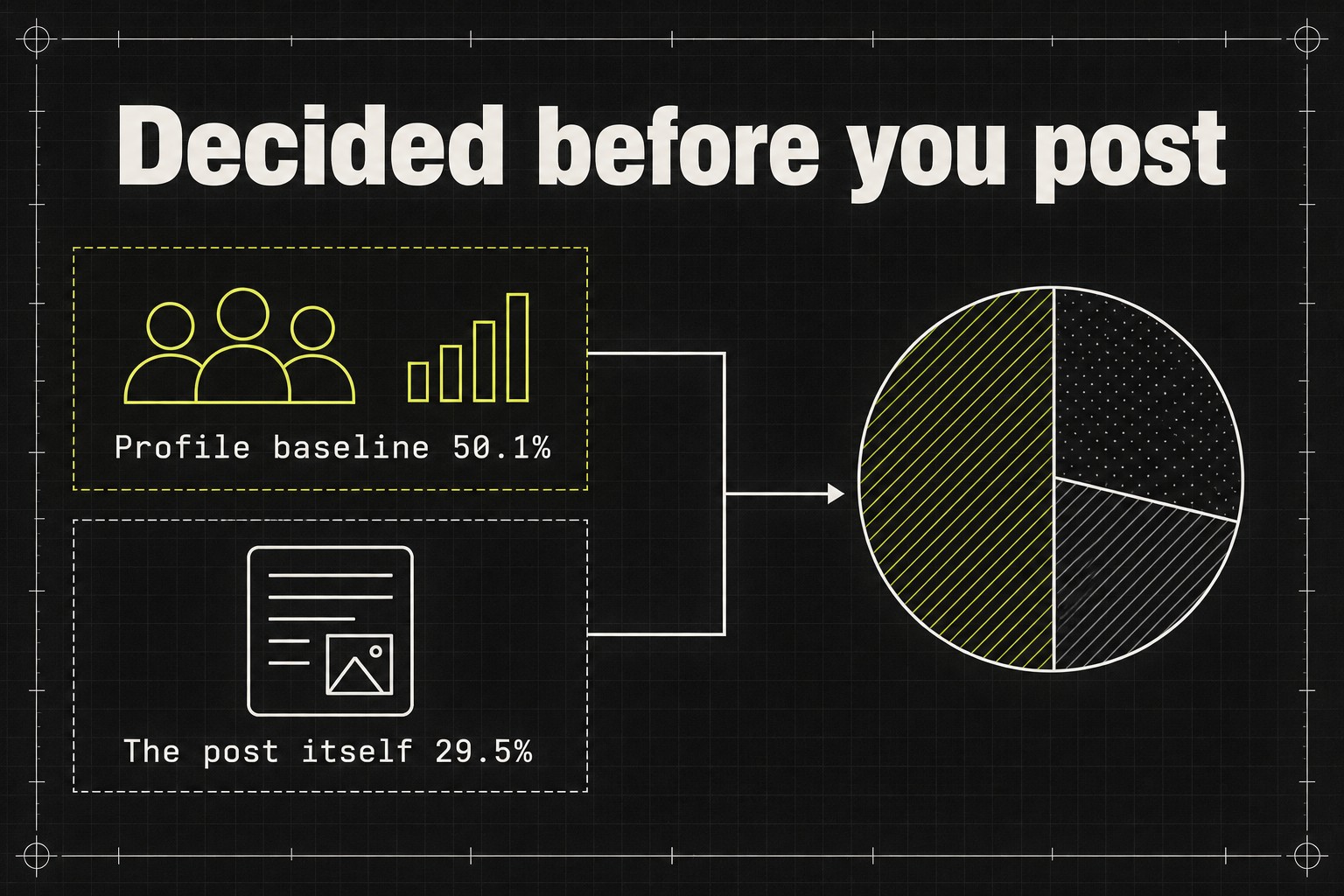
Short on time? Richard van der Blom's Algorithm Insights Report, built on 1.3 million LinkedIn posts, attributes 50.1% of a post's impressions to the author's profile baseline, meaning followers plus how previous posts performed. The post itself accounts for 29.5%. Forbes published the top findings on 26 November 2026. The same dataset puts the reach penalty for fully AI-written posts at 30 to 40%, finds posts with ten or more saves earn a median 2,086% more reach while 97.7% of posts get none at all, and shows direct connections' share of the feed falling from 72% in 2024 to 31% now. If you grow on LinkedIn by posting and commenting, the instruction in the data is to stop treating each post as its own bet and start building the baseline that decides half your reach before you hit publish.
Where these numbers come from
The Algorithm Insights Report is independent research by Richard van der Blom's team and has no affiliation with LinkedIn. The 2026 edition analysed more than 1.3 million posts from over 80,000 profiles and company pages, with a core data window of March 2025 to February 2026 and a November 2026 update built on a further 800,000 posts. The full report is paid. Forbes' Jodie Cook published seven of the top findings on 26 November 2026 with van der Blom's permission. Every figure in this post is cross-checked against a source you can open, van der Blom's own public posts, data published by his research partner AuthoredUp, or other coverage of the report, and linked where it appears.
Half your reach is decided before you post
The headline finding: when van der Blom's team modelled what drives impressions across the dataset, 50.1% traced back to the author's profile baseline, follower count plus the performance of previous posts. Only 29.5% depended on the post itself. The rest sits with timing and context.
Sit with what that does to the usual advice. Most LinkedIn guidance is about the post: the hook, the format, the posting time. The data says the post is the minority input. Your last ten posts are part of your next post's distribution, so a weak post does not just underperform, it lowers the baseline the next one inherits, and a strong one pays out twice.
Follower count alone will not save you either. Across the research period median follower counts grew 31% while median impressions fell, and organic reach is down more than 70% from its February 2024 peak. A bigger audience no longer buys you distribution; what counts is whether the smaller number who do see each post are the right people.
What the baseline rewards is legibility. The feed now matches posts to people interested in their topic, so pick two or three topics, put them in your About section, and check whether a stranger could name them from your last 30 posts alone. If they could not, the matching model cannot either. We have written about how LinkedIn decides which strangers see your posts, and this study is the strongest external evidence yet that the profile, not the post, is the lever.
Direct connections fell from 72% of the feed to 31%
In 2024, 72% of the posts in a LinkedIn feed came from direct connections. In 2026 that figure is 31%, which means most of what members see now comes from outside their own connections. LinkedIn rebuilt its feed ranking around models that work out what a post is about and route it to people who care about that topic. "We want the Feed to be relevant to your interests, not a popularity contest," the company said in its announcement, "How LinkedIn Is Improving the Feed".
Members feel the change, and plenty resent it. Pawel Brodzinski, who writes on leadership in technology, describes the same shift in a November 2026 post about building his own LinkedIn feed: "By 2023, we had posts from outside our network. This year, an LLM took control of the algorithm." His fix was to code himself a reader that pulls posts only from people he hand-picked; he still reads and reacts on LinkedIn itself, he just skips the feed. As a poster, your position is the opposite: a feed full of strangers means your next post will mostly be judged by people who have never heard of you. Write the first two lines for them: who you help, what happened, with a real number from your work, so someone outside your network knows within two seconds whether the post is for them.
Saves move reach more than any other reaction
97.7% of posts get zero saves, by van der Blom's own count, and the posts that collect ten or more earn a median 2,086% more reach. His research partner AuthoredUp calls saves the strongest single signal, driving roughly 60% more resurfacing of a post.
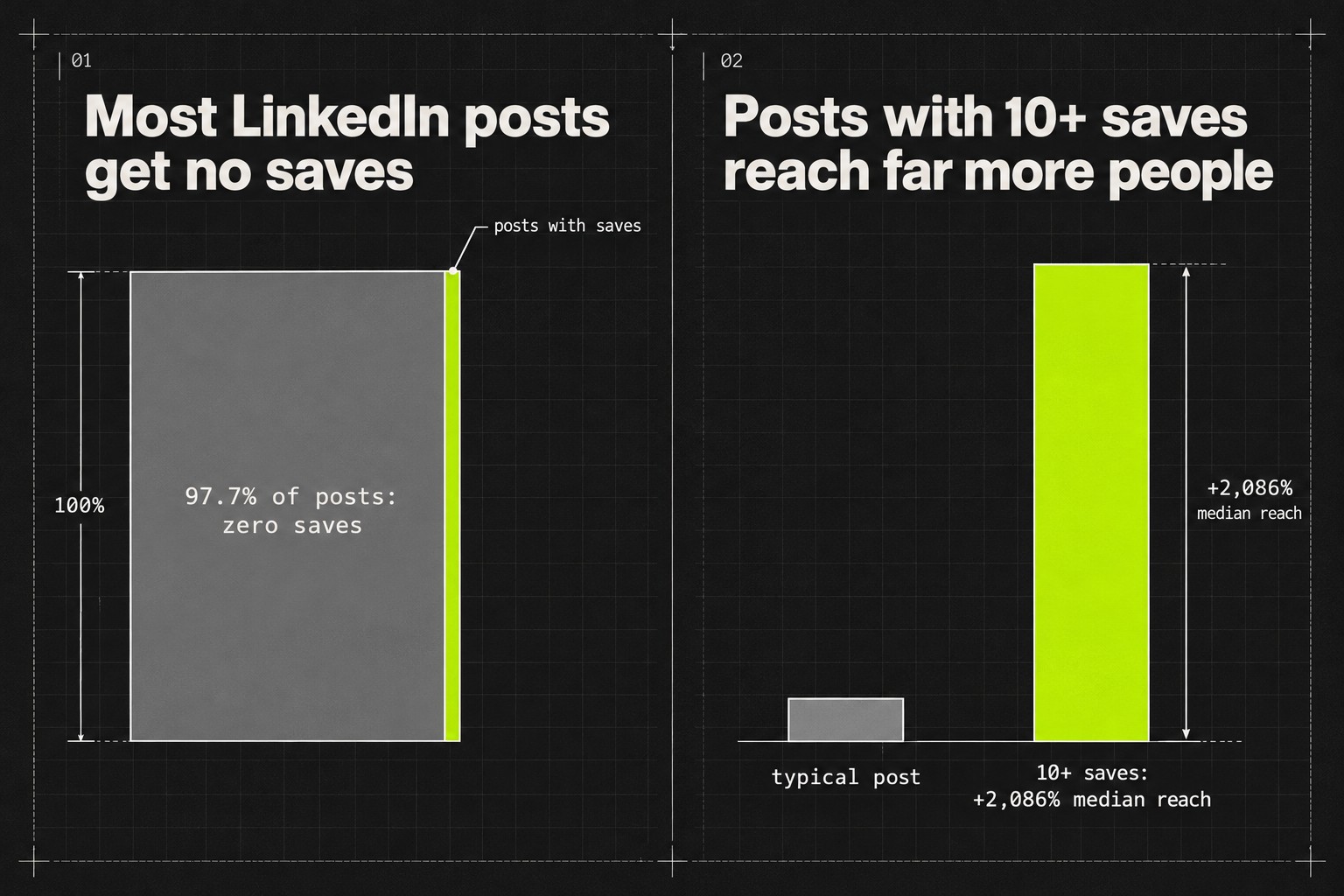
Some of that gap is selection. Posts worth saving are better posts, and better posts would reach further anyway, so do not read a 20x gap as a dial you can turn by begging for saves. But the direction is still useful: people save what they expect to use again. A checklist from your actual client work, the exact message you send after a discovery call, a process with the rough edges left in. If a post is advice, shape it as the thing the reader will want open next week, and say so in the last line.
The AI penalty is really a generic-content penalty
Fully AI-generated posts take a 30 to 40% reach penalty in the dataset. Posts where AI helped with research or structure and a person added the story show a smaller decline of around 10%. LinkedIn says its AI-slop classifiers now screen every post distributed beyond the poster's immediate network, at 94% precision. Laura Lorenzetti, VP and executive editor of LinkedIn Global Editorial, put it this way in a Forbes interview: "It's not about whether or not you used AI. LinkedIn is looking for recycled ideas and generic content that feels not new and not authentic."
That matches what LinkedIn has said about how its slop detection works: the target is sameness, not tooling. The practical line to draw is specificity. Use AI for research and outlines if you like, then write the opening and the particulars yourself, because the model does not know your client's name, your number, or what went wrong in week two, and those are exactly the details the filter cannot flag as generic.
Formats and links: small choices with measured costs
Document posts, the PDF carousels, get 1.39 times average reach and 1.30 times average engagement, and stay one of the platform's most underused formats. Video's reach multiplier fell 22.5% in a year. Polls hit a 1.78x reach multiplier, the highest of any format, with a 0.37 engagement multiplier, the lowest: they travel everywhere and convince no one.
Links are the quieter tax. One external link in the post body cost a median 18.8% of reach in the April data; later practitioner data puts the current single-link penalty at roughly 16%, lower but not gone. The old workaround is worse than the problem it dodged: comments containing external links lose up to 80% of their visibility, and a link in a comment converts 3.4 times worse than the same link in the post. LinkedIn brought back pinned comments in mid-October, but van der Blom's team measured over 3,000 of them and found only 12% of a post's readers ever see a pinned link. The honest conclusion is that no placement makes links free, so put them where conversion is best and accept the reach cost on the posts where the link is the point.
What to do now
- This week: read your last 30 posts as a stranger would. If your two or three topics are not obvious, fix the About section and plan the next month's posts around them. The baseline that drives half your reach is built here.
- This month: turn your best-performing text post into a 7 to 11 slide document post, one idea per slide, and end it with a reason to save.
- Ongoing: write openers for people who have never heard of you, and keep links out of posts whose job is reach. When the link is the point, put it in the post itself: only 12% of readers ever find one pinned in a comment.
- Stop: publishing fully AI-written posts under your name. A 30 to 40% reach cut is the measured price before anyone in your network notices the sameness. The same logic applies to comments, where a ranking model already decides who sees yours.
One thing not to do: panic about reach being down 70% and buy ads to compensate. Plenty of accounts have quit posting altogether, and every one of them leaves room for the people still writing.
The caveats the coverage skipped
Three things to hold loosely. First, this is observational data, so the big correlations are not levers: saves predict reach partly because good posts earn both. Second, the figures are medians from a paid report reaching the public through summaries, and the report's core window ended in February 2026 while its November 2026 update added newer data; the public excerpts do not always say which findings come from which window, so treat precise decimals as the report's, not gospel. Third, LinkedIn confirmed the direction of several findings but none of the numbers, and the one first-party number here, the 94% precision figure, is LinkedIn grading its own work. Precision also says nothing about how much slop gets through: it measures how often the classifier is right when it flags a post, and LinkedIn has not published recall, the share of generic posts it catches at all. The pattern across all of it still points one way, though, and it is the same thing the reach data has said all year: the profile and the habit compound, the individual post does not.