Table of Contents
- 1. What LinkedIn published
- 2. How the matching works
- 3. The gate: one action from outside your network
- 4. What this means if you grow by posting and commenting
- 5. What to do now
- 6. Frequently asked questions
- 6.1. What is LinkedIn's Profile Relevance model?
- 6.2. Why is my post not reaching people outside my network?
- 6.3. Does engagement from my connections help my post reach strangers?
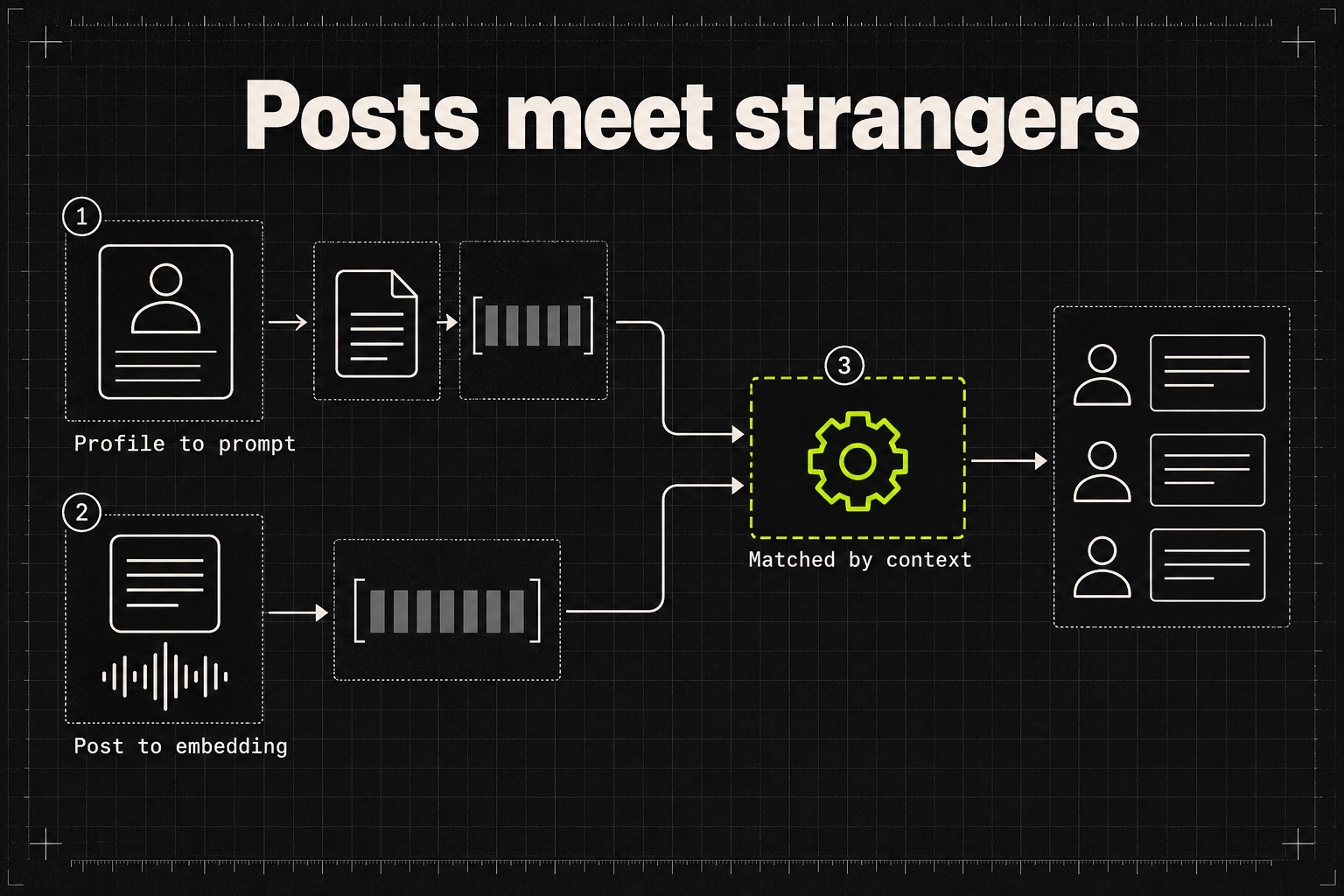
Short on time? LinkedIn has published the mechanics of Profile Relevance, a key system LinkedIn uses to pick which posts get shown to people who do not follow you. It summarises each member's profile into a prompt with an LLM, turns each post's text into an embedding, and matches the two by professional context. Two details in the November 2026 engineering post should change how you write. First, a matched post is still held back until one unconnected member likes, comments on or shares it; read naturally, that means someone outside your network, so applause from your own circle likely does not open the door. Second, the matching reads the words in your post and your profile, so vague writing now costs reach, not just credibility.
What LinkedIn published
A post by Shiyong Lin and colleagues on the LinkedIn Engineering Blog (November 9, 2026) describes Profile Relevance, one of the retrieval sources behind what LinkedIn calls Unconnected Content: posts in your feed from people you do not follow. Older recommendation systems leaned on network proximity and engagement history, which made it hard for posts to travel beyond the author's immediate network, especially for creators still building an audience. The new system keeps those network and engagement signals and adds matching by professional context alongside them: an embedding of the reader's profile against an embedding of the post's text. To check that the resulting recommendations are actually relevant, LinkedIn grades them with AutoEval, an LLM-based evaluation framework. LinkedIn writes: "The system evaluates how well each post matches a member's professional context across specific factors, including topic, location, job title, company, industry, seniority, and education."
Social Media Today reported the post on November 9, 2026. LinkedIn's own experiment numbers are modest in aggregate: a 0.54% lift in feed updates viewed, a 0.94% increase in viral rate, and an 18.8% drop in how often members hide posts. The exception is new and quiet accounts. For what LinkedIn calls cold-start members, people with little activity history, viral engagement rose 17.7%. That figure describes readers, not authors: members with little activity history saw more posts from beyond their networks worth engaging with. What LinkedIn says about authors is separate, and it is the point above: the older systems made it hard for creators still building an audience to be discovered.
How the matching works
On the reader's side, LinkedIn builds a prompt from the professional information in each member's public profile: headline, summary, skills, work history and education. It leaves out the member's name and gender. That prompt becomes an embedding, a numeric summary the system can compare against posts.
On the author's side, the embedding is built from the post's text, its title, and the transcript if it is a video, plus author metadata such as location. One finding from LinkedIn's own testing is worth pausing on: when an LLM rewrote text before embedding it, subtle geographic cues got lost, so the team now appends both the reader's and the author's country, taken from their profiles, directly to the prompts. Regional posts are meant to find regional readers.
None of this is keyword matching. But it is still text matching. A post that never names its topic, the kind that opens with three lines of suspense and a life lesson, gives the model very little to place it with. The same applies to video: the transcript is what gets embedded, so a talking-head clip that never says the subject out loud is invisible to the matcher in exactly the way a vague caption is.
The gate: one action from outside your network
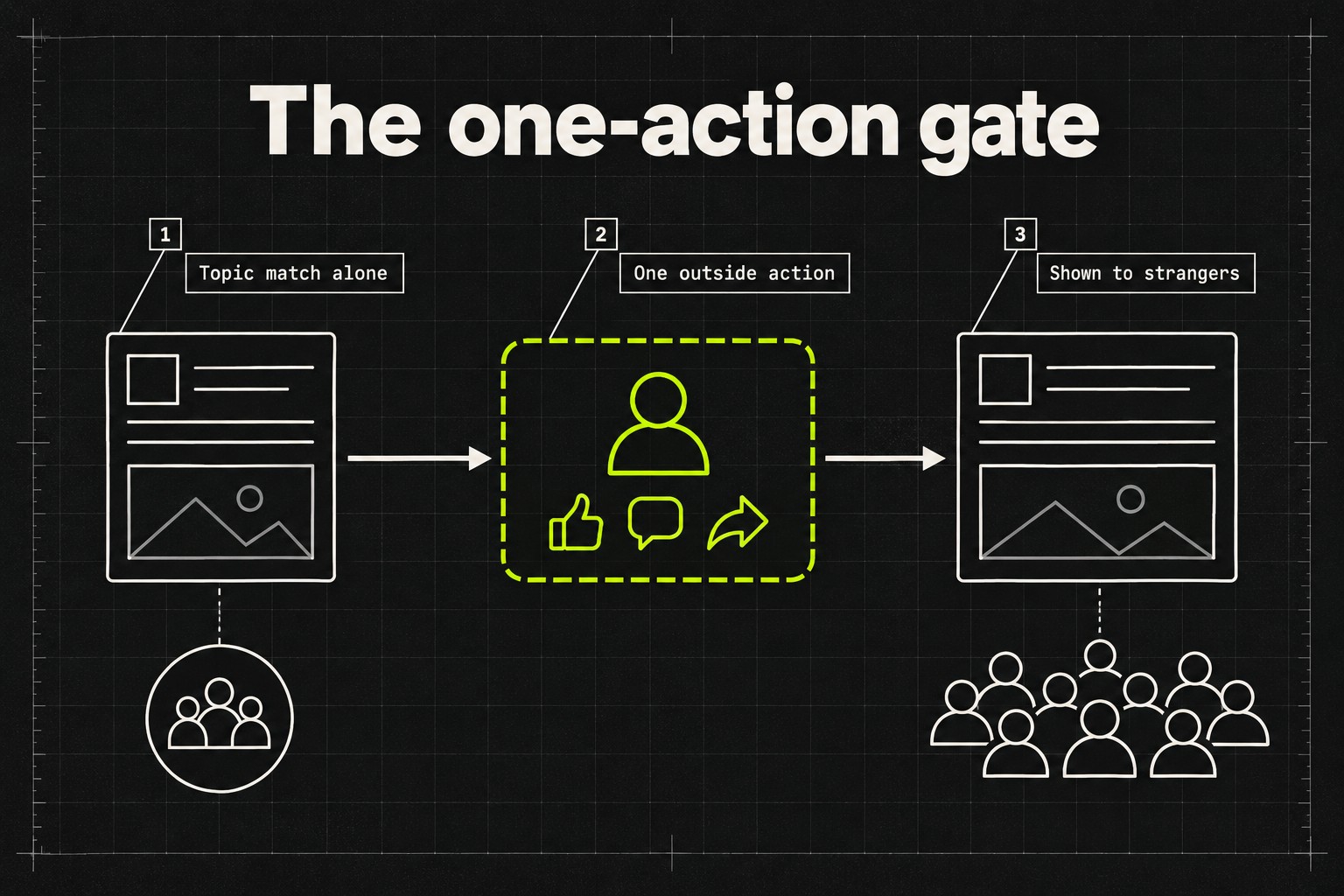
A detail Social Media Today's write-up did not mention is the engagement threshold. LinkedIn found that topical matching alone was not enough, because a post can fit someone's interests without any sign that other members find it valuable. So it added a floor: posts from Profile Relevance "must have received a single viral action (like, comment, or share) from an unconnected member before being recommended." LinkedIn does not say whom that member must be unconnected from; the natural reading is someone outside the author's network. On that reading, your post can match ten thousand strangers' profiles and still not be recommended to them through Profile Relevance until one person outside your network engages with it.
Read that against what people are actually planning. In a r/LinkedInTips thread this week, a user who posted regularly a couple of years ago and picked it up again two weeks back reported reach in the few hundreds where they used to see a few thousand, and proposed a WhatsApp group where members react and comment on each other's posts. That is a coordinated engagement group, which LinkedIn's rules prohibit, and it leaves the public footprint that got engagement pods banned and scored by creator-vetting tools this year. On the reading above, the reactions that come from members who are already your connections likely do not count toward the gate either.
What this means if you grow by posting and commenting
The practical shifts are specific. Your post's text is now targeting data, so name your topic in plain words somewhere in the first lines: the role, the industry, the problem. You are writing for two readers, the person and the matcher, and the words that help one help the other.
Your profile is targeting data too, in the other direction. The prompt built from your headline, summary and skills decides what you get shown, and LinkedIn refreshes it when your profile changes. A headline that says what you actually work on gets you a feed, and a commenting ground, in your actual field.
And the first stranger matters more than the next fifty likes. Once one unconnected person engages, a matched post becomes eligible to be recommended through Profile Relevance to strangers whose professional context its text matches. The reliable way to be known by people outside your network is still the one we keep coming back to: commenting well on other people's posts, where unconnected readers already are. That is how strangers end up on your profile in the first place, and a stranger who arrives and engages is the key this system now turns. The feed's move toward interest-matched distribution is the same direction LinkedIn signalled when it started testing separate Network and For You tabs.
What to do now
- This week: put the topic in the text. Check your last three drafts. If the subject, role or industry is never named in plain words, the embedding has little to work with. Say it in the first two lines.
- This week: say the key terms out loud in video. Transcripts are embedded. A video that never speaks its subject matches nothing.
- This month: fix your headline and skills. Write them in the vocabulary of the people you want to reach. The model reads them to build your feed, and your edits propagate when your profile changes.
- Ongoing: earn the first outside action. Comment where unconnected readers in your topic already are, and end your own posts with a question a stranger can answer. One real action from outside your network opens that distribution, and on the reading above, applause from inside it likely does not count.
Do not build a pod to game the gate. Connections' reactions, on that reading, likely do not count toward it, and coordinated engagement is both against LinkedIn's rules and visible to anyone who reads your comments. And do not stuff posts with job titles like it is 2012 search. The model is matching meaning, not counting keywords; one clear naming of the topic beats ten.
Frequently asked questions
What is LinkedIn's Profile Relevance model?
It is a retrieval system, described on LinkedIn's engineering blog in November 2026, that helps decide which posts appear in the feeds of people who do not follow the author. It uses LLM-generated embeddings to match a member's profile against a post's text by professional context, and grades whether those recommendations are relevant with an LLM-based framework called AutoEval, which scores factors including topic, location, job title, company, industry, seniority and education.
Why is my post not reaching people outside my network?
Two likely reasons under the published mechanics: the post's text never names its topic clearly enough to match anyone's professional context, or it has not yet received a like, comment or share from someone outside your network, which is the threshold a post must cross before Profile Relevance recommends it to non-followers.
Does engagement from my connections help my post reach strangers?
It helps with your network's feeds, but LinkedIn says a post must receive a single viral action from an unconnected member before Profile Relevance recommends it. LinkedIn does not define unconnected member; the natural reading is someone outside the author's network, and on that reading your connections' engagement likely does not count toward the gate.
The bottom line: LinkedIn has told us what one of its systems for showing posts to non-followers reads: your post's words, your profile's words, and one action from outside your circle. All three are things you control by writing clearly and showing up where unconnected readers already are. As of November 2026, the vague post and the vague headline carry a new cost: the matcher cannot place them, so the strangers they were meant for never see them.