Table of Contents
- 1. What LinkedIn said on October 23
- 2. The folklore this should end
- 3. The classifier is real. The word list is not
- 4. What this means if you grow by posting and commenting
- 5. What to do now
- 6. Frequently asked questions
- 6.1. Does LinkedIn have banned words in 2026?
- 6.2. Does using AI to write posts reduce LinkedIn reach?
- 6.3. What should I do when a LinkedIn post flops?
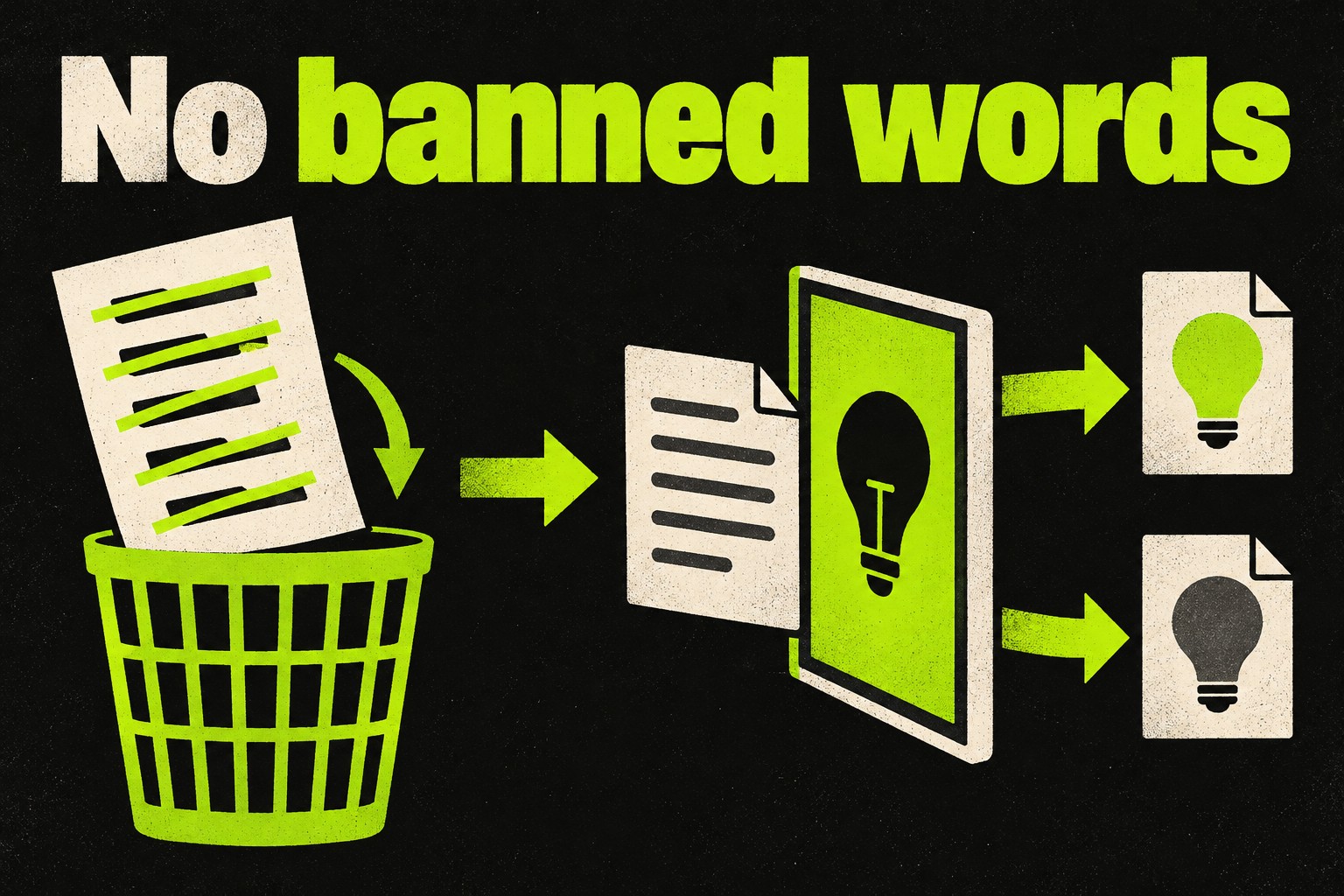
Short on time? LinkedIn has no banned words. That is now on the record: in a Forbes interview published October 23, 2026, Laura Lorenzetti, VP and executive editor of LinkedIn Global Editorial, said "there is no single thing we look at that reduces reach." What decides whether a post travels is a screen for recycled ideas, not a vocabulary list. If you have been pruning "delve" from drafts and counting emojis, you have been optimising against a filter that does not exist, while the one that does exist reads your first two sentences and asks whether anyone else could have written them.
What LinkedIn said on October 23
Forbes contributor Jodie Cook asked Laura Lorenzetti, who runs LinkedIn's global editorial team, how the feed decides who sees a post, and published the answers on October 23, 2026. Three of them matter more than the rest.
The first is the denial. "There is no single thing we look at that reduces reach," Lorenzetti said. Cook puts it more bluntly: contrary to rumour, LinkedIn has no banned words.
The second is what the screen actually is. LinkedIn runs what it calls a generic classifier. "It's not about whether or not you used AI. LinkedIn is looking for recycled ideas and generic content that feels not new and not authentic," Lorenzetti said. The unit of judgment is the idea, not the wording. A post can use every phrase on somebody's "words that kill your reach" list and travel fine, provided the thing it says is new. A post can scrub all of them and still get buried, because a recycled idea survives a synonym pass untouched.
The third is where the judgment lands. "People know in the first two sentences," she said. Cook turns that into a test worth stealing: cover your name and read your opening two lines. If someone else could have written them, replace them with a number from your own work or an opinion your peers would argue with.
The folklore this should end
Spend an hour in any LinkedIn community and you will meet the tripwire theory of reach: the algorithm supposedly keys on specific words, emoji counts, links, or some other mechanical tell, and your job is to find the list and stay off it. The same week as Cook's interview, r/LinkedInTips hosted a thread titled "Help Understand New Algorithm: Do's and Don'ts?", and another asking how to get unstuck on impressions drew answers pointing at everything from posting times to profile keywords. One commenter there got closer to the Lorenzetti version than most paid guides do: "LI algorithm changed recently. It analyzes your profile and content to understand the main topic you are writing about," wrote u/Ivan_Palii, arguing that consistency between your profile and your posts now matters more than any single trick.
The tripwire theory was always convenient. A banned-words list would mean your flop was a technicality, fixable with a find-and-replace. The on-record version is less comfortable. The screen is reading for whether your post contains anything that did not already exist, and no checker tool can pass that test for you.
The classifier is real. The word list is not
None of this means the screening is folklore too. LinkedIn has spent 2026 building exactly the machinery Lorenzetti describes, and it has been unusually public about it. In July it added a "seems like AI slop" feedback option, and Chief Product Officer Hari Srinivasan said the platform detects and blocks hundreds of thousands of automated slop comment attempts every day, plus "billions of other automation attempts" over a couple of months (Fortune, July 31, 2026). By mid September, LinkedIn said more than a million members had used the feedback option within two weeks and that views of content its classifiers mark as slop were down 40%, a figure it attributes to several interventions together (Let's Data Science, September 15, 2026). In October its VP of Engineering explained the detection system itself, which we unpacked in our breakdown of how LinkedIn detects AI slop: classifiers now screen every post distributed beyond your immediate network.
Read together, the two halves of the message are consistent. Srinivasan said in July that using AI is not the offence. Lorenzetti says in October that no word is the offence. The offence is genericness, and both executives describe the same enforcement point: the gap between the audience you already have and the audience you want.
Lorenzetti also offered something rarer than a warning: a diagnostic. When a post flops, she suggests working through the causes one at a time. "Was it the time I posted it? Was it the actual content? Was it just not that interesting? Was it the subject matter? Or was it how I wrote it?" Some flops have no clear cause, in which case "maybe you could try reframing it and reposting it," she said. Cook's own method is to rewrite the first line, keep everything else, and repost a week later.
What this means if you grow by posting and commenting
Word-list hygiene is now officially a placebo. Running a draft through a banned-words checker treats the symptom. AI-flavoured vocabulary usually rides along with a generic idea, so the two get mistaken for each other, but the classifier is aimed at the idea. Swap every suspect word and a template post is still a template post. Our guide to why LinkedIn content stops ranking covers what actually moves distribution.
A flop is a diagnosis, not a verdict. The instinct after 29 views is to delete the post and guess. LinkedIn's own editorial lead says the opposite: walk the question list, and if nothing explains it, reframe and repost. Deleting destroys the one data point you paid an hour of writing for.
Comments sit inside the same screen, and have all year. The hundreds of thousands of blocked comment attempts a day are the automated end, but the standard applies to the words too. A comment that restates the post above it is generic by definition; it could appear under any post, from anyone. The comments that survive this regime respond to the specific argument, which is the bar our commenting guide sets and the one we hold Commentify to. If your comments could be reassigned to a different post without anyone noticing, they are feeding the classifier training data.
One caveat the coverage mostly skips: "no single thing reduces reach" does not mean nothing reduces reach. It means the signals are plural and weighed together, which Cook's closing list spells out as original ideas, timing that matches when your followers are online, honest flop diagnosis, a rotating portfolio of post types, and a trusted profile. A classifier verdict is one input into how the LinkedIn feed ranks a post, not the whole machine.
What to do now
Four steps, ordered by urgency.
- This week: run the cover-your-name test on your last ten openers. Hide the byline and read the first two lines. If a stranger in your field could have posted them, rewrite them around a number, a client moment or a position only you hold.
- This week: resurrect one flop instead of mourning it. Pick a post that deserved better, rewrite its first line only, and repost it next week. That is the platform-sanctioned move now, straight from the interview.
- This month: retire the banned-words checklist from your workflow. Keep editing for clarity, but stop treating vocabulary as a ranking lever. Spend the recovered time on the idea audit, which is the test that actually runs.
- This quarter: vary your formats deliberately. Recycled ideas include your own. If every post is the same story shape that worked in March, you are templating yourself, and the classifier does not care who wrote the template.
Two things not to do. Do not delete flopped posts in a panic; a flop carries the diagnostic information and deletion throws it away. And do not conclude that AI tools are banned. Both executives have said the opposite all year. The line sits between AI that tidies your idea and AI that replaces it, the same line LinkedIn drew when it swapped its AI post writer for a proofreader.
Frequently asked questions
Does LinkedIn have banned words in 2026?
No. Laura Lorenzetti, VP and executive editor of LinkedIn Global Editorial, said in a Forbes interview published October 23, 2026 that "there is no single thing we look at that reduces reach." LinkedIn screens for recycled, generic content with a classifier; it does not keep a list of penalised words.
Does using AI to write posts reduce LinkedIn reach?
Not by itself. Lorenzetti said the generic classifier is "not about whether or not you used AI" but about recycled ideas and content that feels inauthentic. LinkedIn has separately reported that views of content its classifiers mark as AI slop are down 40%, so generic AI output does lose reach even though AI assistance is allowed.
What should I do when a LinkedIn post flops?
Diagnose before changing strategy: check the timing, the subject, the interest level and the writing, in that order. If none of them explains it, LinkedIn's editorial VP suggests reframing the post and publishing it again. Rewriting the first line and reposting a week later is a practical version of that advice.
The bottom line: as of October 2026, the person who runs LinkedIn's editorial operation says no word, emoji or link will bury your post, and a classifier hunting recycled ideas might. The find-and-replace era of LinkedIn optimisation was always superstition, and now there is a named executive on the record saying so. The test that remains is harder and fairer: write an opening two lines nobody else could have written, and the rest of the machine works in your favour.