Short on time? LinkedIn's comment section is a ranked surface with its own product team. Travis Hutchinson, the senior product manager for conversations, AI and growth, told an AfroTech Conference panel this week that his job is the machine learning behind which comments members see, and that nearly 700 million comments are viewed on the platform every day. Between writing a comment and anyone reading it sit an automation screen and a relevance model, and above both sits the author's new pin slot. As of November 2026, every comment competes for ranked positions the way posts do. The practical move: write fewer comments, make each one specific to the post it sits under, and aim for the pin.
What LinkedIn said at AfroTech
On November 4, Hutchinson spoke in LinkedIn's session "Getting Discovered in the LinkedIn Feed" at the AfroTech Conference in Houston, and AfroTech published the interview on November 5, 2026. His background explains why LinkedIn gave him this brief: he was a product manager at Instagram from 2019, worked on Explore relevance, and was on the team that launched Reels. LinkedIn hired him in 2022. His current job is comments. "My task is, how do we make comments to be the most relevant experience overall," he said. "So, let's say [someone] comes to the platform. What kind of comments should [they] be seeing."
Two numbers from the panel are worth keeping, both from LinkedIn's own material. Members view nearly 700 million comments a day, according to insights LinkedIn presented at the session. And in LinkedIn's survey data, more than a quarter of Black professionals credit commenting, sharing and joining professional conversations with access to new opportunities, the highest of any racial or ethnic group surveyed, according to LinkedIn data. Hutchinson put it plainly: "This is how people land roles and jobs. Commenting on someone's post, and then somebody sees something, and they reach out to you and get to make a relationship. I focus on what's the machine learning underneath what comments we show you."
That last sentence is the news. LinkedIn has a senior product manager, with a feed-ranking background from Instagram, whose stated focus is the machine learning behind which comments you see.
Nearly 700 million daily views are allocated, not scrolled
A comment thread looks chronological. It is not. On a post with four hundred comments, only a few are shown before the "see more" fold, and a relevance model, the area Hutchinson works on, decides which few those are. The same logic that made the feed a ranking contest years ago now runs one level down, inside the thread.
LinkedIn's motive is explicit. "When we have the opportunity to show people comments, we know that they tend to have a significantly better experience overall," Hutchinson said. Comments keep people on the platform, so LinkedIn surfaces the ones it predicts will start conversations. For anyone who grows by commenting, that is good news with a condition attached. Good comments are promoted inventory now, pushed in front of readers the way posts are, which is the mechanism behind the visibility case our commenting guide makes. The condition is that a model, trained on what members actually read and reply to, decides what counts as good.
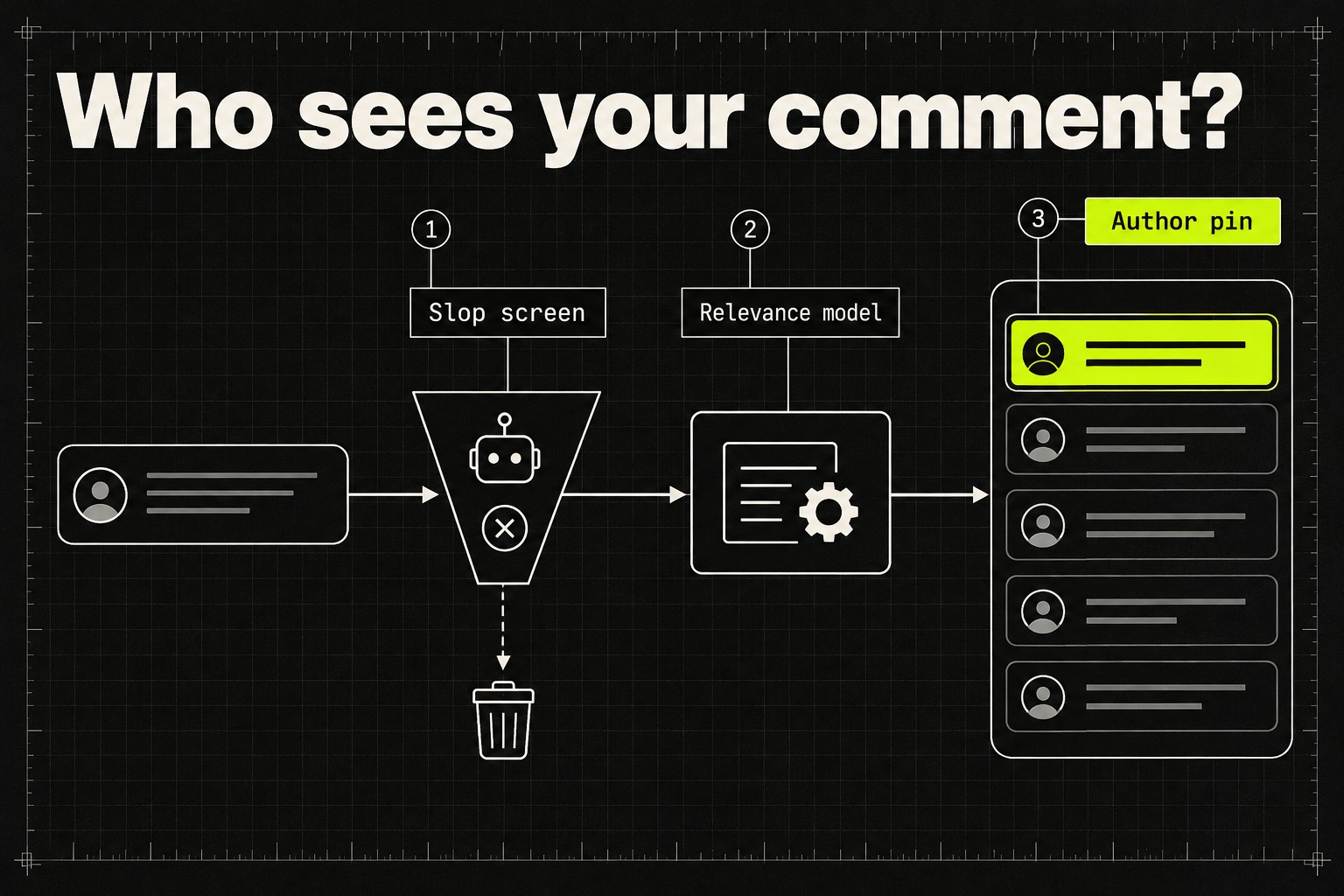
The screen your comment passes first
Before a comment can be ranked, it has to survive the quality screen, and LinkedIn has spent 2026 describing that screen in public. In July, Chief Product Officer Hari Srinivasan said LinkedIn detects and blocks hundreds of thousands of automated slop comment attempts every day, and has prevented "billions of other automation attempts (posting at scale, slop) in the last couple months alone" (Fortune, July 31, 2026). In October, VP of Engineering Tim Jurka described the teacher-student classifier system that learns from the million-plus slop reports members have filed, which we broke down when LinkedIn explained its slop detection.
At AfroTech, Hutchinson said comments are part of the same quality effort. He called it "a general quality push" and said LinkedIn has made architectural improvements for it: "The industry standard is you focus on classifiers and feed ranking … to make sure that people are seeing high-quality posts and comments."
Put the three announcements together and the pipeline is clear. An automation screen drops bulk comments at the door. Classifiers mark generic text and bury it. A relevance model ranks whatever survives. Template praise loses twice in that pipeline: "Great post, thanks for sharing" is both the pattern the classifiers trained on and the comment no relevance model would ever predict a reader wants. If a tool writes comments for you, the only output worth publishing is a reply that engages the specific post, which is the bar we hold Commentify to.
The pin is the one ranking decision a human makes
On October 15, 2026, LinkedIn brought pinned comments back: "Authors can now pin helpful comments, making it easier to highlight valuable contributions and guide the discussion," per the announcement (Social Media Today, October 15, 2026). LinkedIn first tested pins in 2022 and shelved them. According to AfroTech, pinned comments are among the features Hutchinson's team worked on, and were developed in response to creator feedback. It was announced in the same October update as a test of ad revenue sharing for creators and paid Advice Sessions, which we covered when LinkedIn put a price on creator work.
For commenters, the pin is a top slot that no model assigns and no budget buys. Only the post's author can grant it. Think about what an author pins: the comment that makes their post look smarter. A correction with a source. A number from your own experience. A respectful counter-argument that sets up a real discussion. Write one of those under a post that is travelling, get pinned, and your name sits above every other reply for as long as the post keeps earning impressions. That is distribution the old "first comment within five minutes" trick never delivered.
What to do now
Four moves, in order.
- Reread your last twenty comments as the model would. For each one, ask whether it could appear under a different post without anyone noticing. A portable comment is an unrankable comment. The ones worth writing could only exist under that specific post.
- Trade volume for depth. Fifty generic comments a week feed the classifier's pattern pool and earn nothing. Ten comments that quote the post, add a number or push back with reasons give the relevance model something to surface.
- Write for the pin. Before commenting on a post you care about, ask what the author would want at the top of their thread. Evidence, a worked example, or a sharp question beats applause every time.
- If you automate, keep the bar at "responds to this post." Srinivasan's numbers say bulk commenting gets blocked at the door, and the July crackdown made clear the screen is watching scale. Tools that read the post before replying are competing in the ranked pool; tools that spray templates are donating training data.
One thing not to do: do not chase visibility by commenting faster or earlier. Speed was a proxy for the chronological era. In a ranked thread, a specific comment posted three hours late is more likely to be surfaced than a generic one posted first.
The bigger picture
LinkedIn spent October explaining how it buries generic posts and how it measures creators, and spent this week explaining who ranks the comments. The three stories are one story. Conversation is the product LinkedIn is selling now, and it is being managed like one: screened for slop, ranked by relevance models, measured in the new per-post analytics, and topped by an editorial slot the author controls. People who learned to write posts for the feed's ranking need the same discipline one level down. The comment section has an algorithm of its own, and as of November 2026 you know the name of one of the product managers working on it.