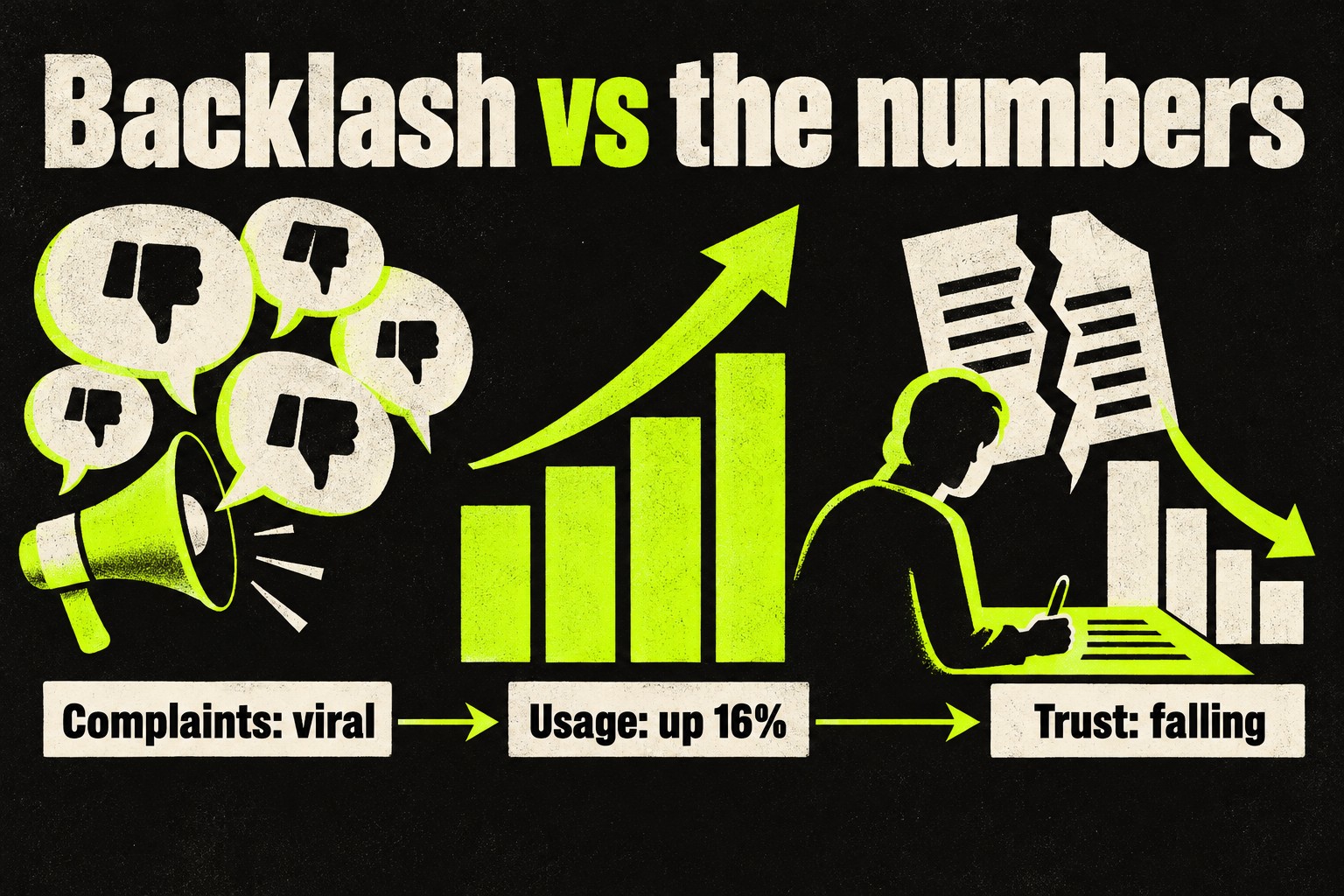
Short on time? On 16 November a post went viral on X: "The SpaceX engineers who caught the rocket don't write LinkedIn thought pieces about leadership." IBTimes UK counted around 30,000 likes and more than 700,000 views the same day, and a round of coverage followed asking whether LinkedIn is losing its appeal. LinkedIn's own October figures say the opposite: more than 1.4 billion members, feed views up more than 16% year on year. Both are real. The feed is not emptying. It is filling with writing nobody believes a person wrote, and that is the useful fact. As of November 2026, the cheapest way to stand out on LinkedIn is to sound unmistakably like yourself, because most of your competition has stopped trying.
What happened this week
The backlash crested on 16 November, when several users criticised LinkedIn on X on the same day. IBTimes UK collected them the same day. John LeFevre's SpaceX line drew the biggest numbers. Another user called the platform "genuinely becoming unusable.. just a never-ending feed of ai slop, fake productivity and people congratulating themselves for doing absolutely nothing." A third said asking unemployed job seekers to pay for Premium, whose Career plan starts at £29.99 a month in the UK, is "insane."
This was not one disgruntled user having a bad morning. Startup Fortune read the episode as a trust problem rather than an exodus, and that is the right frame. The loudest complaints are not about missing features. They are about no longer believing that the person who posted wrote the post.
The numbers say crowded, not dying
LinkedIn reported in October 2026 that it has more than 1.4 billion members, that feed content views rose more than 16% year on year, and that time spent in the feed rose more than 15%, per IBTimes UK's summary of the company's figures. Registered members are not active users, as IBTimes UK itself notes, so carry that caveat. Even so, nothing in the public data shows people leaving.
What the data does show is what the feed is now made of. Pangram, an AI-detection firm, scanned just over a million social media posts through its browser extension between late April and July 2026. More than 40% of long-form LinkedIn posts flagged as fully AI-generated, the highest rate of any platform it measured. LinkedIn supplied a third of the posts in the dataset and 62% of everything flagged as AI. CNN's October report put the comparison plainly: around 30% of long-form posts on X and Medium, and a smaller share on Reddit and Substack.
So the honest summary of the week is this. Attention is up, and a large share of what gets posted is machine-written. The viral complaints and the growth numbers describe the same feed.
Trust is the number that is falling
A professional network sells one assumption: the name on the post belongs to the person who wrote it. Every polished leadership essay that turns out to be prompt output spends a little of that assumption, and it spends it for everyone, including the people still writing their own material.
LinkedIn is not disputing any of this. It shipped a "seems like AI slop" report option on 30 July 2026, and more than a million members used it within two weeks, per IBTimes UK. By its 15 September update the company claimed a 40% reduction in views of content its systems classify as slop. The machinery behind that number is now built out across the whole platform: former journalists train the post classifier, everything distributed beyond your own network gets screened, and in mid-November LinkedIn said it is rolling out classifiers that push suspected AI comments down threads, and building notifications that only surface high-quality comments.
LinkedIn's editor-in-chief Dan Roth summed up the editorial line to CNN in October: "I know you think you're doing the right thing with your perfectly bulleted list and your hook at the top, and you followed all the advice from LinkedIn advisors across the internet. But what works is being human."
What this means if you grow by posting and commenting
Three practical readings, in order of how fast they bite.
First, the backlash names the formats that are now liabilities. The complaints and Roth's quote describe the same post: hook on line one, bulleted list, emojis, an engagement ask at the end. That template now costs you twice. Readers scroll past it because it pattern-matches to slop, and the classifier restricts its distribution for the same reason. The format is a tax in late 2026.
Second, the comment section is where trust is thinnest. Pangram found a top-level LinkedIn post was 1.35 times more likely to be AI-generated than a comment, but when it controlled for length the effect reversed: comments came out slightly more likely to be AI than posts. Short, portable praise is the most machine-saturated writing on the platform, and in November LinkedIn said it is extending its classifiers to comments. A reply that quotes the post and adds something only you could know is competing against the weakest field the platform has ever had.
Third, the viral joke is a brief, not just an insult. The SpaceX line lands because everyone knows the people doing impressive work mostly are not writing thought pieces about it. That is the shortage. A post about the work you actually did this week, with the numbers and the dead ends left in, is the one thing the feed cannot get from a model.
What to do now
Four moves, most urgent first.
- Retire the template this week. If your drafts open with a one-line hook and run on bullets with emojis, rewrite the next one as plain paragraphs that say what happened and what you think. You are not optimising for a format anymore; the format is the flag.
- Post one specific thing from your own work. A number, a mistake, a client conversation, a decision you got wrong. Specifics are the cheapest trust signal available, and they are the part a model cannot supply, as we argued when LinkedIn first explained its detection system.
- Reread your last ten comments next to the posts they sit under. If a comment would make sense under a different post, it is portable praise, and portable praise is what both readers and the new comment classifiers have learned to skip. Commenting still builds visibility, but only the kind that engages the actual argument.
- Stay. The alternatives in this week's coverage, Contra, Substack, XING, Reddit, are places to supplement a presence, not to move one. The buyers, hiring managers and recruiters are still on LinkedIn, and the platform's own engagement figures show attention has not left. Leaving now means walking out of a room just as your loudest competitors lose their microphones.
One thing not to do: do not read any of this as AI assistance being banned. LinkedIn's stated definition of slop is low-effort content that lacks a point of view, not everything written with AI help. The test is whether the output sounds like you and says something, not which keyboard produced it.
The bigger picture
People have complained about LinkedIn for years and kept logging in, and this cycle will not empty the platform either. What makes November 2026 different is that the platform agrees with the complainers. The slop button, the classifier, the comment filters and Roth's interviews all point the same direction: LinkedIn is re-ranking its feed in favour of people who write like people, because, as Roth told CNN, too many generic posts risk losing members to other platforms. Backlash weeks look like bad news for the platform. For anyone willing to write plainly about real work, this one is a subsidy, and it is being handed out while most of the feed is still pasting from a chat window.