Short on time? LinkedIn's editor-in-chief Dan Roth told CNN on 18 October that the people training its AI-slop classifier are mostly former journalists, and that the posts most at risk are the ones built from standard LinkedIn advice: the hook at the top, the bulleted list, the ask for engagement. A flagged post stops travelling beyond your direct connections, and LinkedIn says views of content classified as slop are already down 40%. The useful way to read this: it is a taste filter, not an authorship test. A templated post you typed by hand can fail it. An AI-assisted post that sounds unmistakably like you can pass. As of October 2026, the format is the tell.
What LinkedIn told CNN
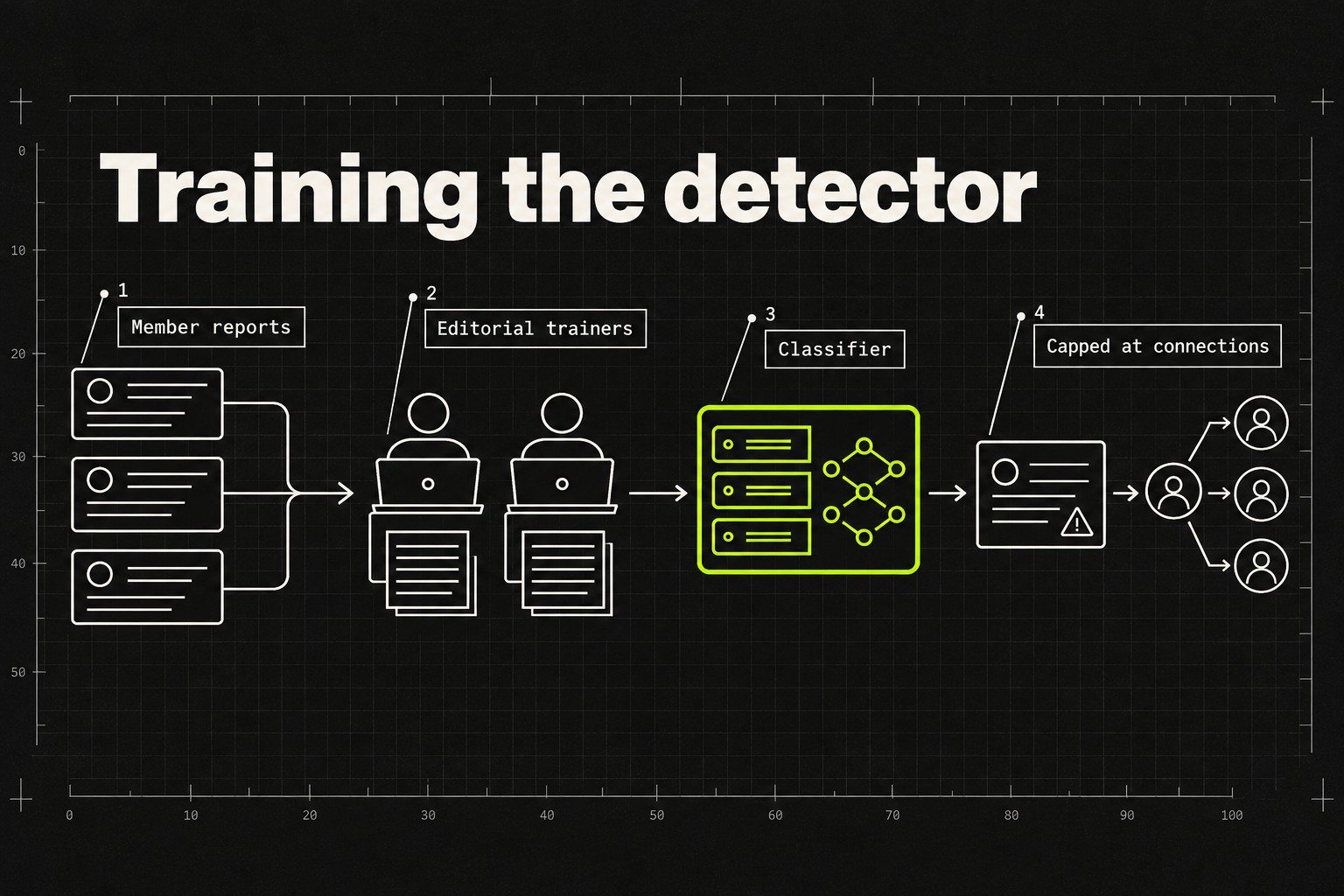
On 18 October 2026, CNN published an interview with Dan Roth, LinkedIn's editor-in-chief, about the platform's fight against generic AI posts. Most of the campaign was already public. What is new is who runs it. LinkedIn built a team made up largely of former journalists and social media specialists whose job is to recognise generic content on sight and teach LinkedIn's AI model what an authentic, useful post looks like. When the model flags a post as low-quality AI content, that post becomes less likely to be distributed beyond the author's direct connections.
The same team doubles as what Roth calls "content therapists" for executives and subject-matter experts, and his account of those sessions is the sharpest thing in the piece. People draft a post, "run it through Claude or Gemini or wherever," publish it, watch it die, then come asking why. Roth's answer: "The best thing you can do is give it back to them and be like, 'Did you enjoy reading this? Do you see yourself in this?'"
The numbers around the interview are familiar but worth restating. The "seems like AI slop" report button that arrived in August was used more than a million times in its first two weeks, and LinkedIn said in September that views of content its systems classify as slop have fallen 40%, both figures CNN attributes to LinkedIn's own announcements. The raw material is not in dispute either. Pangram, the AI-detection firm, scanned just over a million social posts in the months before its July report and flagged more than 40% of long-form LinkedIn posts as fully AI-generated, against roughly 30% on X and Medium (Pangram, July 2026). LinkedIn supplied a third of the posts in that sample and 62% of all the AI content found in it.
This is a taste filter, not an AI detector
The quote worth keeping from the CNN piece is this one: "I know you think you're doing the right thing with your perfectly bulleted list and your hook at the top, and you followed all the advice from LinkedIn advisors across the internet. But what works is being human."
Notice what that implies about the training data. The editors on Roth's team were not labelling posts "written by a model" and "written by a person"; they have no way to know. They were labelling posts generic or authentic, by reading them. So the classifier's real target is the generic register, the voice a decade of LinkedIn advice taught everyone to imitate and AI tools now reproduce at volume. That cuts both ways. A post you wrote yourself, by hand, following that same playbook is made of the exact patterns the editors condemned. And Roth says plainly that AI help is fine: "not everyone is a born communicator." What fails is output that reads like it could sit under anyone's name.
The product decisions line up with that. LinkedIn used to offer tools that would write or punch up your post, and CNN notes it has scaled those back; in September it replaced its AI post writer with a proofreader, software that corrects your words instead of producing them. The company that sells Copilot by day is telling its members to stop pasting model output by night, which tells you how expensive the slop problem has become.
Do not expect the reporting pressure to ease, either. The top comment on r/technology's thread about the CNN piece, 269 upvotes, argues LinkedIn caused this by shipping AI tools to make posting easier, "and guess what: that wasn't the problem." Whoever is right about the blame, the irritation that produced a million reports in two weeks is still there, and every report is a free training label.
What changes if you grow by posting and commenting
The guru template is now a liability, even handwritten. Roth named the bulleted list and the top hook specifically. If your posts are built from a formula you learned in a carousel about going viral, the formula is the signature the classifier reads, whoever typed it. The topics can stay. The packaging has to go.
Comments sit inside the same net. One detail from Pangram's data that the coverage skipped: a top-level LinkedIn post was 1.35 times more likely to be AI-generated than a comment, but once you control for length, comments were actually slightly more likely to be AI than posts. Short generic replies are everywhere, and LinkedIn's systems have been catching automated comments for months. If a tool drafts comments for you, the only output worth publishing is a reply that engages the specific post above it, which is the standard our commenting guide argues for and the bar we hold Commentify to. Template praise is what the button was built for.
The penalty is designed to be invisible to you. Nothing gets removed. A flagged post still reaches your own connections, who are the people most likely to like it anyway, so your feed experience looks normal while the distribution that actually grows an audience is withheld. We covered the machinery behind that screening when LinkedIn's VP of engineering described it on 8 October: classifiers now check posts at the gate between your network and everyone else. The CNN interview adds the part machines cannot supply, the editorial taste the classifiers were trained to copy.
What to do now
Four moves, in order.
- Strip the format before you worry about the words. Take your last ten posts and delete the hook, the bullets and the closing question. Whatever survives is the post. If nothing survives, that is the finding.
- Reverse where AI sits in your workflow. Draft in your own words first, then let a model proofread. That is the exact division of labour LinkedIn built into its own tools, and editing your words produces a different surface than generating them. Our guide to avoiding AI content pitfalls walks through the workflow.
- Hold comments to the same bar as posts. A comment that could sit under any post in your niche is slop by LinkedIn's definition, whether a tool wrote it or you did at speed.
- Check post analytics if reach drops. LinkedIn's September update says authors whose posts draw enough slop reports may see a private note in their post analytics (Let's Data Science, 15 September 2026). That note is a process warning. Change how the posts get made, not just the next topic.
Two things not to do. Do not swear off AI assistance to be safe; Roth himself says that is not the ask, and a proofread post is not the target. And do not delete and repost content that underperformed in the hope of a second roll. The classifier that read it the first time has not changed its mind.
The bigger picture
CNN points out that YouTube, Pinterest and Spotify have all moved against mass-produced AI content this year, so LinkedIn is part of a queue. What makes its version interesting is the choice to put editorial judgment at the centre, journalists teaching a model to recognise writing that says nothing, inside a company whose parent sells the tools that produce most of it. As of October 2026 the direction is explicit and public: generic output is being made worthless on the one platform where professionals had normalised it. The durable response has not changed since August, and no future tightening will touch it: bring the observation only you have, in your own register, and keep the machines on cleanup duty.