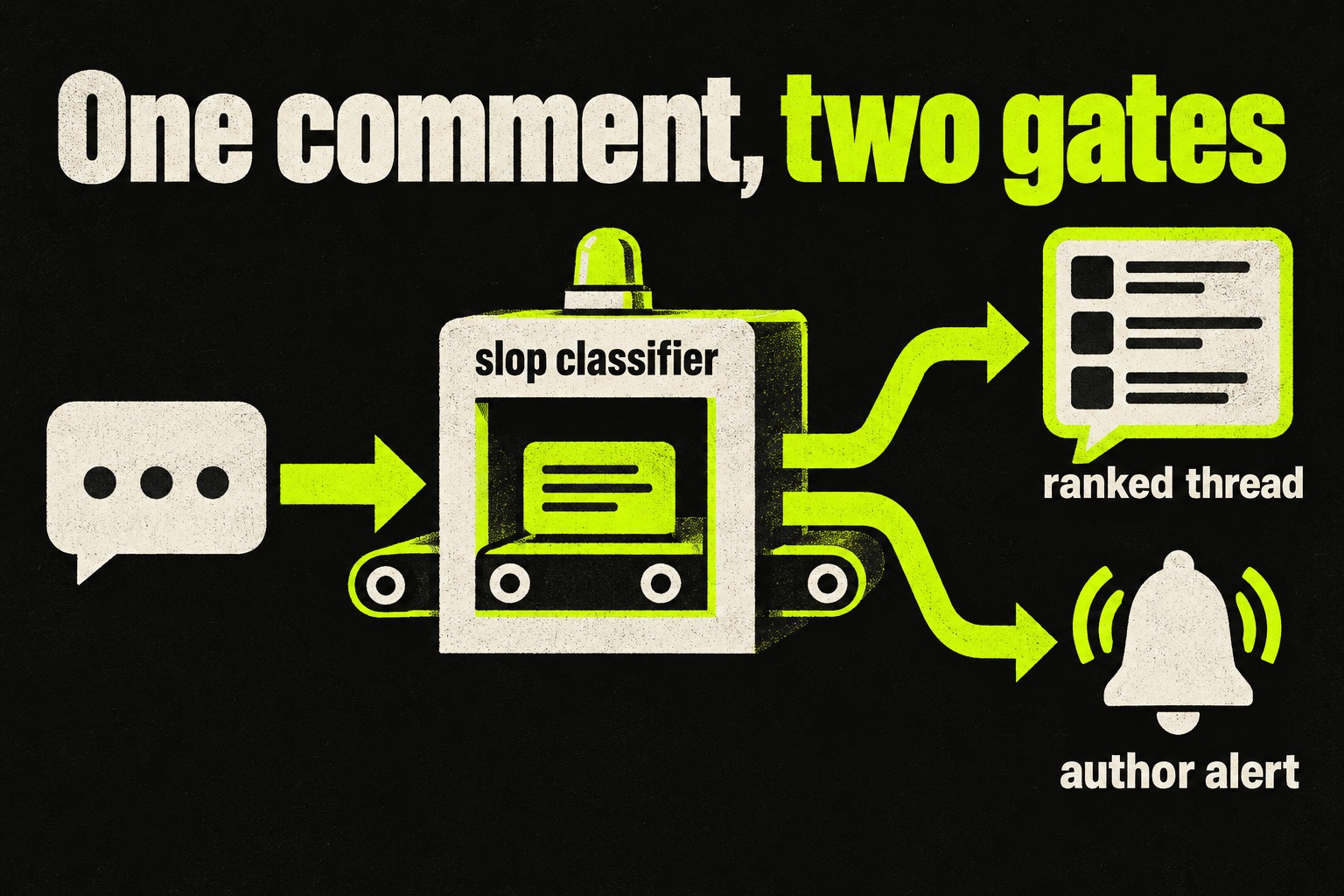
Short on time? LinkedIn is rolling out new classifiers that push suspected AI-generated comments out of the "most relevant" section of comment threads, plus a notification filter that only alerts post authors to "high-quality comments you're likely to care about." In testing, LinkedIn says views of slop comments fell by more than 20%. The feed demotion costs a generic comment its readers. The notification filter costs it the author, who was the person most comments were written for in the first place. As of November 2026, a comment that could sit under any post is the kind LinkedIn is now working to show to fewer people, and to stop notifying the author about.
What LinkedIn announced
On November 13, 2026, LinkedIn Chief Product Officer Hari Srinivasan said the platform's slop crackdown has reached the comment section. Two changes are rolling out. New classifiers judge the relevance of comments and treat suspected AI slop as less valuable, so a thread viewed with the default "most relevant" ordering shows fewer of them. And LinkedIn has started building smarter notifications so that creators, in Srinivasan's words, only hear about "high-quality comments you're likely to care about."
"In testing we're already seeing a >20% reduction in views of slop comments, and they will be rolled out to everyone soon," Srinivasan wrote. Social Media Today's November 15 report adds the operative detail: suspected AI comments are re-ranked and buried, not removed. In practice, the comment still posts; it just reaches fewer people.
The notification filter is the bigger change
Srinivasan's post led with the feed demotion. For anyone who grows by commenting, the notification change matters more.
Commenting works as a growth channel because of one loop: you leave a sharp reply under someone's post, the author gets a notification, reads it, answers or clicks through to your profile, and a relationship starts. The thread position was always negotiable. LinkedIn already runs a ranking model inside comment threads that decides which few replies appear above the fold, and a strong comment could still win the author over even when other readers never scrolled to it. The notification was the dependable half of the loop. LinkedIn has started filtering it too. If the classifier decides your comment is not one the author would care about, the author may never learn it exists.
That breaks the arithmetic of volume commenting. Fifty template replies a day used to produce fifty notifications on fifty authors' phones, and even a thin response rate paid for the effort. Once the notification filter reaches everyone, those same fifty replies have to get past it first. Each comment will have to clear the question "would this author actually want to read this?", because an algorithm will ask it on the author's behalf before the notification fires.
"Suspected AI" is a style, not a tool check
Social Media Today describes the new classifiers as judging a comment's relevance, the same approach as the post-level detection system LinkedIn described in October, which learned from the million-plus slop reports members have filed. So the penalty described here targets a writing style. A hand-typed "Great insight, thanks for sharing!" matches the slop pattern as cleanly as anything a comment generator produces. A reply that quotes the post, adds a number from your own work or disagrees with a reason reads as worth surfacing, whatever produced it.
The pressure for this came from members. A thread on r/linkedin asks, in its title, how people deal with "the amount of nonsense slop" on the platform. LinkedIn's own reporting option told the same story earlier: when it became the first platform to let members flag a post as AI slop in August, more than one million people used the option within three weeks, per Social Media Today. In effect, the comment classifiers extend that machinery from posts to replies.
Why LinkedIn keeps tightening this
There is also a commercial motive worth knowing about. AI chatbots lean on platforms whose content carries some form of member vetting, and Social Media Today notes LinkedIn has become one of the top sources for AI chatbot citations. Likes, replies and follower counts are the vetting. A comment section full of machine praise devalues exactly the signals that make LinkedIn content citable. Expect this to keep tightening; Srinivasan ended his post with "there is still more to come."
What to do now
Four moves, in order of urgency.
- Reread your last twenty comments before the rollout finishes. For each, ask whether it names anything from the post it sits under. A comment you could paste elsewhere without anyone noticing is the pattern the classifier was trained to bury.
- Write for the author's notification, not the thread. The question that used to be optional is now enforced by software: would this specific person want their phone to light up for this? A question about their actual argument clears that bar. Applause they have read four hundred times does not.
- Drop volume targets. Daily comment quotas made sense when every comment generated a notification. Ten specific replies that survive both gates beat fifty that survive neither, which has been the honest math behind commenting for visibility all year.
- If you use a comment generator, audit its output against the post. Read ten of its recent comments next to the posts they answer. If a comment engages the actual argument, it is competing in the ranked pool; if it is portable praise, it is the kind of comment LinkedIn is now ranking down and filtering out of notifications. That reads-the-post bar is the one we build Commentify against, and this update is why the bar exists.
One thing not to do: do not conclude that commenting is finished as a channel. The update argues the opposite. Every view a buried slop comment loses is a view that flows to whatever the model ranks above it, and for the first time the competition for the author's attention has been thinned out by the platform itself. Specific comments just got a subsidy.
The quiet part
Because the penalty is silent, most people it hits may not notice for weeks. Replies will still post, threads will still fill, and the only visible symptom will be authors who stop responding. If your commenting results drift down over the next month with no other explanation, start from the assumption that the classifier has an opinion about your style, and rewrite before you escalate volume. As of November 2026, the comment section grades on substance, and it does not hand back marked work.