
Table of Contents
- 1. What Changed in 2026: The Algorithm You're Actually Up Against
- 2. LinkedIn Growth with Restricted Engagement: The New Playbook
- 3. Strategic Limited Engagement: Quality Over Quantity
- 4. Engagement Restriction Workarounds: Playing Smart, Not Hard
- 5. Future-Proofing Your LinkedIn Strategy
- 6. Ready to Maximize Your LinkedIn Growth with Limited Engagement?
Picture this: You've just posted what you genuinely believe is your best LinkedIn content yet. You've researched industry trends, crafted compelling copy, and even added a professional headshot that doesn't look like a hostage photo. You hit "Post" with the confidence of someone about to go viral.
Two hours later? Three likes. One comment from your mom. And a cricket symphony that would make a nature documentary proud.
Here's the part nobody tells you: as of October 2026, that silence is mostly not about you. According to Richard van der Blom's Algorithm Insights report, LinkedIn impressions are down roughly 50% year over year, engagement is down about 25%, and follower growth has fallen 59%. The platform deliberately throttled reach for almost everyone. So the real question isn't "why is my engagement low" but "how do I grow when low engagement is the default" and that has a concrete answer: optimize for the signals LinkedIn now rewards (dwell time, saves, comments), track the outcomes that happen off the feed (profile views, DMs, inquiries), and put more of your effort into commenting and direct relationships, where reach limits matter far less.
What Changed in 2026: The Algorithm You're Actually Up Against
Two shifts this year explain most of the "my posts died" complaints.
First, LinkedIn replaced its old content ranking system with 360Brew, a unified AI model that distributes posts by meaning and topic rather than keywords or hashtags. Post consistently about a narrow subject and it learns to show your content to people interested in that subject, even outside your network. Post about everything and nothing, and it can't place you anywhere. Hootsuite's 2026 algorithm guide makes the same point from LinkedIn's own engineering blog: the feed now reads for meaning, and relevance beats recency, so a useful post can keep surfacing days or weeks after you published it.
Second, the March 2026 "Authenticity Update" cracked down hard on engagement bait ("Comment YES if you agree!"), engagement pods, and external link spam. Polls collapsed to a 0.07% engagement rate. Posts with external links get roughly 60% less reach than identical posts without them, and the link-in-first-comment trick is penalized too. If your reach fell off a cliff in March or April 2026, this update is the likely cause, and there's no appeal form. Recovery means changing what you post, not waiting it out.
There's also the first-hour test. LinkedIn shows a new post to a small slice of your network, around 2–5%, and reads how that group responds before deciding whether anyone else sees it. Only about 5% of posts that underperform in the first hour recover to reach a wider audience.
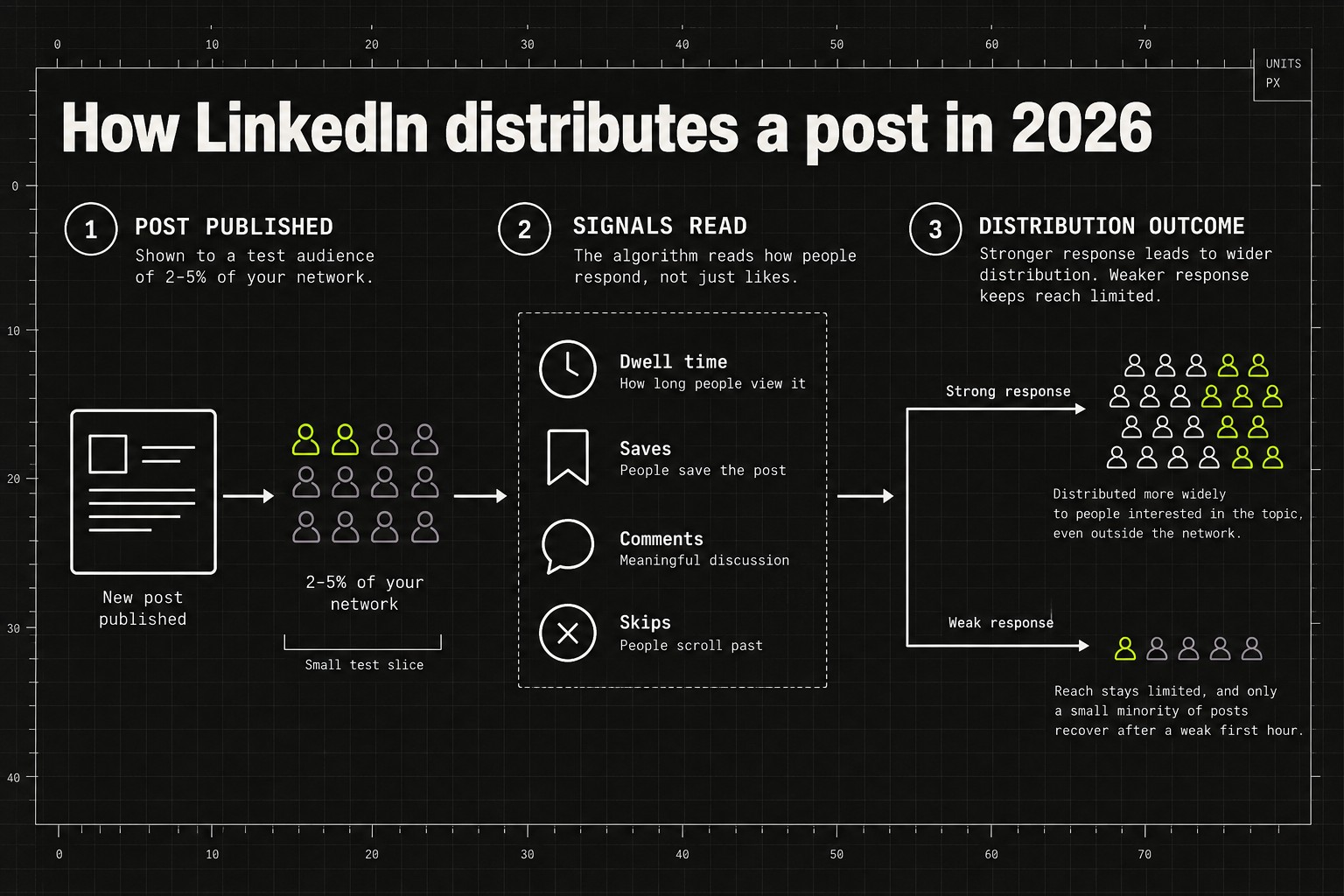
One more thing worth internalizing: LinkedIn says outright that the platform "is not designed for virality." The algorithm watches passive signals like dwell time (how long someone actually reads your post) alongside likes and comments, and it weighs saves and thoughtful comments far more heavily than reactions. A post five people read to the end beats a post fifty people skimmed past.
LinkedIn Growth with Restricted Engagement: The New Playbook
LinkedIn growth with restricted engagement requires a shift from quantity-focused to quality-focused strategies, and in 2026 the platform has essentially forced that shift on everyone.
The foundation is understanding "invisible influence." While your posts might receive limited likes, they can still generate profile views, connection requests, and direct business inquiries. These outcomes often prove more valuable than viral content that generates buzz but no business results.
Track "downstream metrics": activities that occur after someone sees your content, even without public engagement. These include profile visits, connection requests, website clicks, and direct messages. A post with five likes might generate fifteen qualified leads if it reaches the right audience. None of those show up in the reaction count, and the reaction count is the only part your competitors can see.
The goal is content that works as a professional magnet rather than an engagement trap. Instead of crafting posts designed to collect likes (which the Authenticity Update now actively punishes), share insights that make your target audience think, "I need to know more about this person."
Strategic Limited Engagement: Quality Over Quantity
Successful limited engagement growth strategies focus on depth over breadth, and 360Brew rewards exactly that. Rather than trying to appeal to everyone on LinkedIn, pick your specific professional niche and create content that serves that audience exceptionally well. The model builds a "topic DNA" for your profile; two or three consistent themes teach it who should see your posts.
Aim for what I call "expert-level accessibility": content that demonstrates deep professional knowledge while remaining understandable to your target audience. Detailed case studies from your industry, or behind-the-scenes looks at how you make professional decisions, both work well here. Format matters too: van der Blom's data has document posts (PDF carousels) at a 6.6% average engagement rate in 2026 against roughly 2% for plain text, because they hold attention, and attention is the currency now.
The most effective restricted-engagement content often takes the form of mini-masterclasses. A single post that genuinely helps someone solve a work problem will generate more valuable connections than dozens of motivational quotes.
For more comprehensive strategies on building meaningful connections, explore our guide on LinkedIn organic growth which provides additional tactics for sustainable networking.
Engagement Restriction Workarounds: Playing Smart, Not Hard
Engagement restriction workarounds don't involve gaming the system. The 2026 crackdowns made that explicit: pods and bait patterns now get posts buried. What still works is understanding the system well enough to operate within its constraints.
The most effective workaround is diversifying your LinkedIn activity beyond public posting. Thoughtful commenting on others' content, direct message outreach, and strategic connection building are not subject to the same distribution lottery your posts are. A comment on a popular post in your niche puts you in front of that post's audience without needing the algorithm to bless anything of your own. If commenting becomes a core channel for you, our guides on LinkedIn commenting best practices and how many comments a day is safe cover the craft and the limits.
Build "algorithm-independent networking": strategies that create professional relationships regardless of content performance. Use LinkedIn's search to identify relevant professionals, participate in groups, and use event features to meet people. The algorithm can throttle your posts; it can't throttle a conversation.
LinkedIn constraints optimization also means borrowing reach. Build relationships with professionals who share complementary audiences, and engage meaningfully with their content so your name shows up where your prospects already are.
Future-Proofing Your LinkedIn Strategy
The direction of travel is clear from the 2026 changes: LinkedIn keeps getting better at identifying genuine expertise and worse for anyone chasing raw reach. Newsletters now deliver straight to subscriber inboxes, bypassing the feed entirely, and native video keeps growing (LinkedIn reported a third straight quarter of double-digit video upload growth in early 2026). Both are hedges against whatever the feed does next.
The professionals who succeed on LinkedIn from here will be those who consistently provide genuine value to a defined professional community, and who measure success in conversations and inquiries rather than reactions. If you want to go deeper on how distribution decisions get made, our breakdown of the LinkedIn engagement algorithm walks through the ranking signals in detail.
Ready to Maximize Your LinkedIn Growth with Limited Engagement?
Building LinkedIn success despite restricted engagement doesn't have to mean spending hours manually engaging with posts. While authentic relationship building remains the core, strategic automation can help maintain your visibility and expand your professional network efficiently.
Commentify is specifically designed to help professionals like you overcome LinkedIn's engagement challenges. As an intelligent auto comment tool for LinkedIn, Commentify generates thoughtful, AI-powered comments on targeted posts from your industry leaders and ideal connections – ensuring you stay visible and engaged even when you're focused on other priorities.
With LinkedIn's algorithm prioritizing meaningful conversations over surface-level engagement, Commentify helps you maintain consistent, valuable interactions that build professional relationships and expand your network.
Ready to grow your LinkedIn presence without the time investment? Start your free trial with Commentify today and discover how automated, intelligent commenting can transform your LinkedIn growth strategy – even with limited organic engagement.