Short on time? LinkedIn's B2B Institute, working with WARC and Lions Advisory, scored 700 B2B case studies and found that campaigns carrying three or more trust signals, such as customer testimonials, peer validation and visible industry leadership, beat the rest across commercial and brand measures. Only 23% of campaigns cleared that bar. The argument underneath, published 19 November 2026: once buyers believe a product works, the deal goes to the vendor the buying group can defend choosing. If you sell through your own LinkedIn presence, that is an instruction to change what you post. Capability proof gets you shortlisted. Customer stories and visible relationships get you bought.
What the study says
On 19 November 2026, Mimi Turner, global head of thought leadership strategy at LinkedIn's B2B Institute, published the institute's latest research with WARC and Lions Advisory, How To Build More Buyable Brands. The team scored 700 B2B case studies against a set of "buyability" signals: customer testimonials, peer validation, evidence of industry leadership and the like. A campaign with three or more signals counted as high buyability. Only 23% of the sample, 158 campaigns, qualified.
That small group outperformed the rest across commercial and brand measures, and was 1.7 times more likely to be rated a "Strategic Asset", the top rung of the WARC B2B Effectiveness Ladder, reserved for campaigns that drive sustained commercial growth. Customer-centric insight appeared in 83% of the high-buyability campaigns, which were also four times more likely to feature customer testimonials (Social Media Today, 19 November 2026).
Turner's summary of the mechanism is worth quoting in full: "Confidence in product capability is still very important. But once baseline requirements are met, the top priority is no longer marginal product superiority or price. It becomes whether the decision can be successfully defended even if outcomes go wrong."
Why "defensible" beats "best"
The premise comes from buyer interviews, not from the campaign data. Across more than a thousand interviews with senior buyers, the institute found that buying groups commit when they can agree on a decision and defend it inside their own organisation. Turner reports that three of buyers' top five emotional deal-breakers at the shortlist stage were about relationships inside the buying organisation: how defensible the decision was to bosses, how aligned the group was, and how easy the process had been. Only one was about the relationship with the seller.
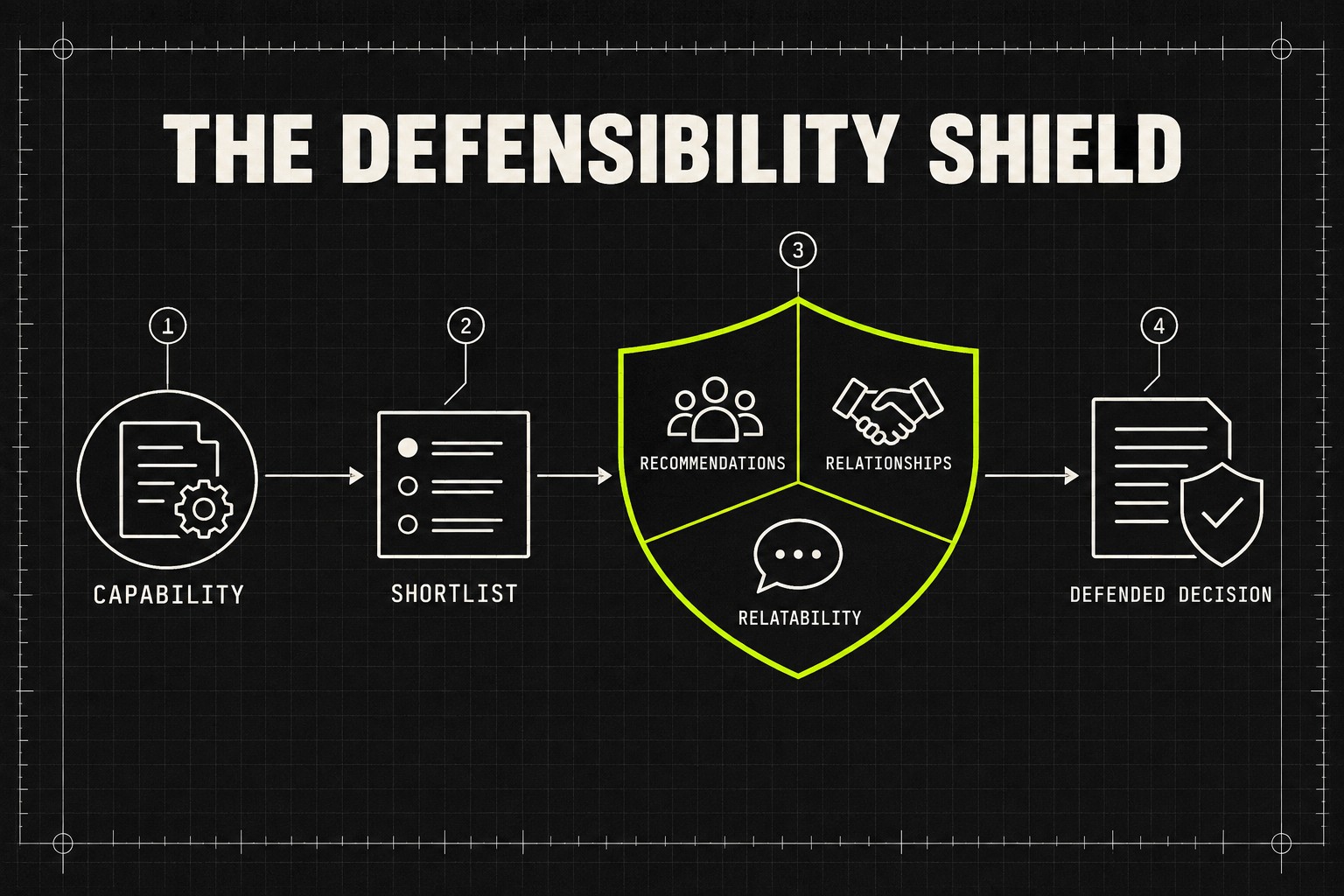
That flips the usual logic of B2B content, which is mostly written to prove the product is better. The buyer's actual problem, once you are on the shortlist, is sounding sensible in a meeting you are not in. Work the institute did with Bain & Company names three signals that solve that problem, a "defensibility shield" of recommendations, relationships and relatability. LinkedIn's own conclusion is that the signals compound and that most marketers underuse them. The 23% figure is the evidence: in a sample drawn from effectiveness case studies, which is the professional end of the market, 77% of campaigns carried two signals or fewer.
LinkedIn's example is ServiceNow, whose brand team built a campaign around the three signals to reach C-suite software buyers, against competitors with marketing budgets LinkedIn puts at up to ten times bigger. The reported results: a 10x lift in consideration, a 13x lift in unaided brand awareness over three years, and subscription revenue up 23% in the same period. Those numbers are reported by LinkedIn, the company that sells the ad space, so hold them loosely. The interview finding does not depend on them.
One caveat the coverage skips: scoring past case studies shows association, not cause. Campaigns able to include strong testimonials may simply have had happier customers to quote. The practical bet still looks sound, because the signals cost little to add and the interview data points the same way, but the study cannot prove that adding them is what wins.
What this means if you sell through your own profile
The study is about brand campaigns with budgets. The mechanism scales down to one person, because the easiest thing for a buying group to check is you. When a founder or consultant makes a shortlist, somebody on the buying side opens their LinkedIn profile, and what they find is either help defending the choice or nothing. A personal brand that generates inbound leads is, in this study's terms, a stock of defensibility built before the deal exists.
Most feeds are weighted like the 77%. Features, demo clips, opinions about the category: all of it answers the question the buyer has already settled, whether the product works. The study rewards the other column. A customer story with a name in it is a forwardable object; your champion can paste it into the internal thread where the decision actually gets argued. WeRSM's read of the research lands on the same point: stop treating testimonials as decoration added at the end of a campaign and build the buyer's defence into the idea itself (WeRSM, 20 November 2026).
Relatability means the buyer can see their own situation. "Great tool, 10/10" survives nothing. A story shaped like the buyer's life does: what the first month looked like, what it replaced, what went wrong and got fixed. The study found customer-centric insight in 83% of the high-buyability campaigns. For an individual that translates to writing about customers' situations more often than about your product.
Relationships are built in comment sections, months before shortlists. Showing up usefully under your buyers' posts answers "how confident do I feel in this relationship" before procurement ever starts, and it is the one signal on the list that costs nothing but time. It has to be consistent to register, which is the case for putting B2B commenting on a system rather than doing it in gaps between calls; keeping that presence daily without it turning generic is the job we built Commentify around.
What to do now
Four moves, in order.
- Sort your last 20 posts into two piles: proves capability, or helps a buyer defend choosing you. If the second pile is the small one, your feed looks like the 77% of campaigns in the study that carried two signals or fewer.
- Publish one named customer story a week. Company, situation, result, rough edges included. Named stories are rarer and heavier than testimonial graphics, and high-buyability campaigns were four times more likely to feature customer testimonials or use cases (64% against 16%).
- Move comment time to where your buyers post. Not your peers, your buyers. Three months of useful presence under their posts builds a relationship signal no cold outreach can fake.
- Make leadership visible rather than claimed. Peer validation and industry standing came up as signals buyers use, and the people treated as industry leaders on LinkedIn earn it with evidence: data they gathered, positions they argued, rooms they spoke in.
One thing not to do: manufacture the signals. Rented engagement reads as peer validation only until someone looks closely, and buyers can now see engagement pods for themselves. Fake defensibility is worse than none, because it hands the sceptic in the buying group their argument.
The bigger picture
The institute's conclusion is deliberately boring. "B2B does not need an Avant Garde creative revolution to build successful creative," Turner writes; the signals that move deals are evidence of happy customers and real relationships. That is the one kind of marketing where a solo operator outproduces a brand team, because a warm network and customers willing to be named are things you accumulate by doing the work, not things you buy. As of November 2026 the professional end of the market is leaving most of that value on the table. 77% is a lot of room.