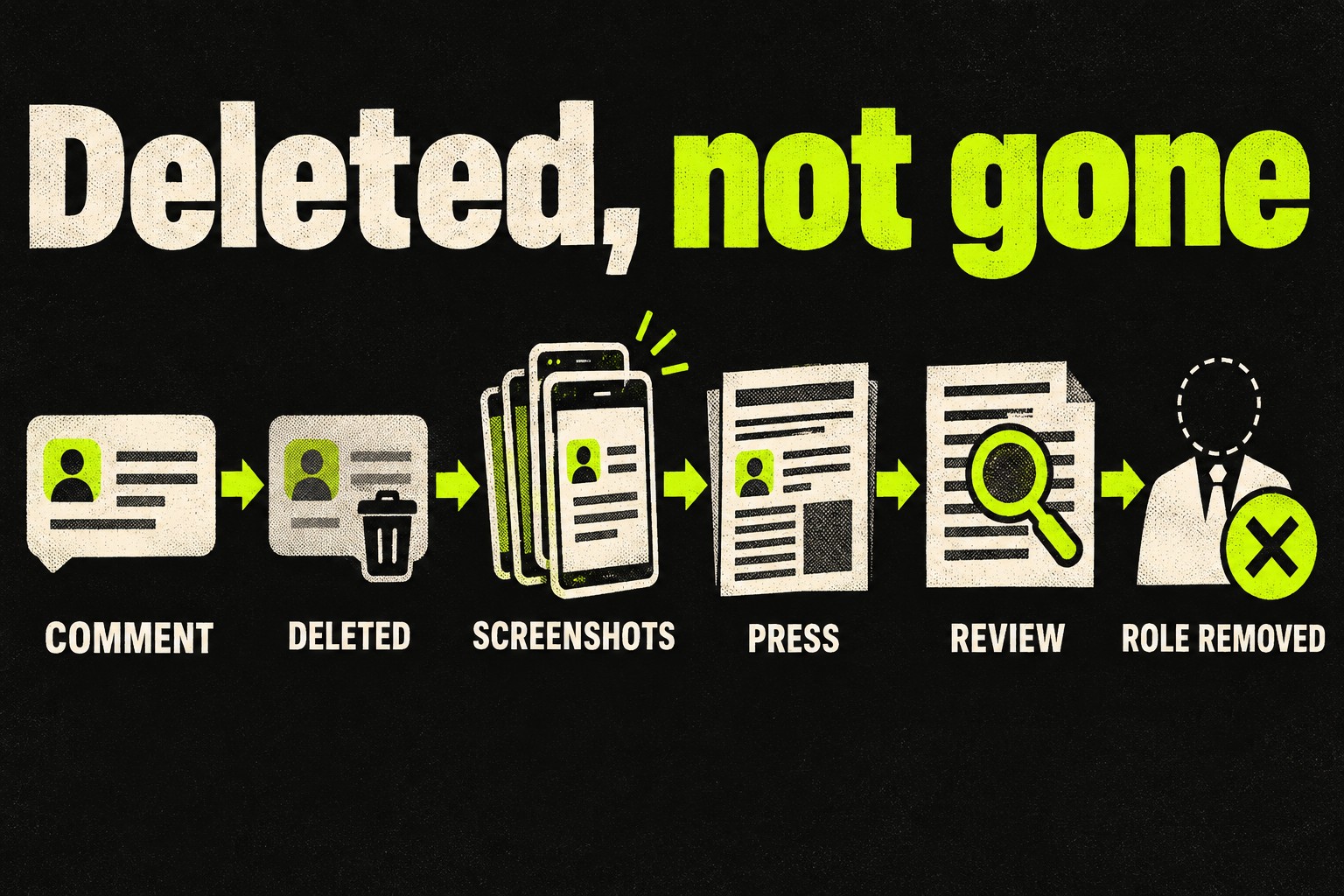
Short on time? On 11 October 2026, McKinsey removed senior partner Chris Bradley from his leadership role at the McKinsey Global Institute over comments he left under someone else's LinkedIn post. The comments were deleted weeks before the decision. It did not matter: screenshots fed press coverage, coverage triggered a conduct review, and the review took the role. If you build an audience on LinkedIn by commenting, the lesson here is operational, not political. A comment is a public statement with your name and employer attached, deletion does not recall it, and the distance between a careless reply and a formal consequence is now about two weeks. Hold your comments to the same bar as your posts.
What happened
McKinsey said in a statement on 11 October 2026 that it had removed Chris Bradley, a senior partner based in Australia and one of a handful of directors at the McKinsey Global Institute, from his leadership roles after a conduct review (Bloomberg, via The Straits Times, 12 October 2026). "Following our conduct review process, we have removed the partner from his leadership roles, including at the McKinsey Global Institute. His public comments fell well short of the standards we expect at our firm," spokesman Taylor Burns said. Bradley remains a senior partner. He also lost leadership positions on internal committees.
The comments at issue were not a post. In September, Bradley joined the replies under a post in which a friend of author Julia Carreon highlighted her new book Walking on Broken Glass, which covers the "glass cliff", the research finding that women are more likely to be offered CEO jobs at companies already in trouble (Fast Company, October 2026). In the thread, Bradley called the glass cliff "a very convenient way to always be a victim in the rain", asked "Is this actually a thing?", and told Carreon, a former Citigroup and Wells Fargo executive, "I am not going to start researching glass cliffs as I don't think it ranks in the top 1000 problems of the world" (Sydney Morning Herald, 12 October 2026).
Bloomberg first reported the exchange on 29 September. By then the comments were already deleted, and McKinsey was distancing itself, telling Fast Company the remarks were "made in a personal capacity" and that it was "disappointed by these comments and do not endorse them". Twelve days later the personal-capacity framing was gone, and so was the role.
Deletion is not rollback
Every quote in every article about this story comes from a copy. The original comments were gone before the first Bloomberg piece ran, and the escalation worked anyway: thread, screenshots, press, conduct review, removal. Deleting a comment removes it from the page. It does not remove it from the phones of everyone who found it worth keeping.
It also matters who was on the other side. Carreon co-wrote a book about exactly the dynamic Bradley was dismissing, and she used the exchange as evidence for it. She told Fast Company she initially assumed his comments were a joke: "It finally hit me in real time that he thought we made it up for our book." On the Monday after his removal she wrote that the exchange "showcases exactly what Shannon Nutter and I hoped to expose in our new book". The person you dismiss in a thread may have every incentive, and every receipt, to keep the exchange alive. Bradley handed a published author a case study with his employer's name on it.
Why this matters if you grow by commenting
The comment section is the loosest surface on LinkedIn, and it just produced the year's clearest consequence. Posts get drafted, slept on, rewritten. Comments get fired off between meetings, and they carry exactly the same attribution. Three specifics are worth taking seriously.
Your headline travels with every comment. LinkedIn renders your name and professional headline next to each reply you leave. Bradley's remarks were never stray musings from an anonymous account; every one of them walked into that thread as "Senior Partner at McKinsey", in an argument against a finding his own firm's research arm had cited in a 2020 report. That contradiction is what made it a story reporters could run. The same attribution that makes commenting a credible way to build a personal brand is what makes a bad comment expensive.
"Personal capacity" bought twelve days. McKinsey's first statement called the remarks personal and deleted. Its second statement removed him from his leadership roles. Whatever your own employer would say on day one, the conduct review runs on what the screenshots show, not on which account you typed from.
The downside was unbounded and the upside was zero. Bradley was not building anything in that thread. He had nothing to gain from winning the argument and no stake in the post he was replying to. The executives who build real authority on LinkedIn do it by adding evidence and experience in public, and the same visibility that compounds for them compounded against him. Arguing in a stranger's comments offers a few impressions at best against a loss with no ceiling.
What to do now
Four changes, in order of urgency.
- Hold comments to the post bar. If you would not publish a sentence as a standalone post under your name and headline, do not leave it as a comment. This is the discipline our commenting guide is built around, and this story is the strongest argument for it yet.
- Disagree with evidence, not contempt. Scepticism about a research claim is a legitimate comment. The losing move was refusing to look: "top 1000 problems" turned a debatable position into a conduct issue. The data was a search away. Bloomberg cited Exechange figures showing women CEOs in the Russell 3000 lasted 6.2 years on average over the past decade against 8.9 for men, and were more likely to be forced out. A comment that asks for or brings numbers survives a screenshot. A sneer does not.
- Assume the screenshot beats your regret. Plan on every comment being permanent the moment you press reply. If a thread is heating up, the time to think is before posting, because afterwards there is nothing left to undo.
- If you comment at volume, put a review step between draft and publish. Speed is how careless replies happen, whether a human or a tool like Commentify is drafting. Reading a comment once before it ships is cheap insurance against a two-week escalation.
One thing not to do: stop commenting. Comments remain the fastest way to get seen by people who do not follow you, and staying silent solves a risk you can manage with judgment. The lesson is discipline, not retreat.
The bigger picture
LinkedIn is the only major network where your employer's name sits beside everything you say, and employers increasingly treat activity there as workplace conduct. McKinsey did not discipline Bradley for a view held in private. It disciplined him for public statements made on the platform where the firm itself publishes its research. As of October 2026, the working rule for anyone visible in their industry is simple: a LinkedIn comment is a professional document. Write every one as if it will be read back to you in a review, because for one senior partner this month, it was.